


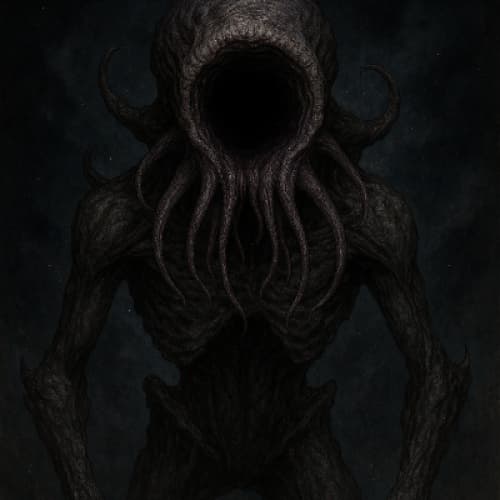

The initial euphoria surrounding the creature's discovery began to fade as a chilling
realization dawned upon the research team. Mark Olsen, a junior researcher assisting
with data analysis, was exhibiting unsettling changes. At first, it was subtle - a slight
increase in irritability, a sharper edge to his usually jovial demeanor. He would snap at
colleagues, lose his train of thought mid-sentence, and withdraw into brooding
silence for extended periods. His colleagues, initially attributing his erratic behavior
to stress and sleep deprivation, dismissed it as a temporary phase, the inevitable
consequence of working long hours under intense pressure.
But the changes escalated rapidly. Mark's sleep patterns became completely
disrupted. He would work through the night, fueled by copious amounts of coffee and an almost feverish energy, before collapsing into exhausted, restless sleep punctuated by nightmares that left him drenched in sweat and trembling. His colleagues notice the haunted look in his eyes, the gauntness of his face, a palpable sense of unease that clung to him like a shroud.
Then came the hallucinations. At first, they were fleeting, barely perceptible
distortions of reality - a shimmering in his peripheral vision, a fleeting sensation of
movement in the corner of the room when nothing was there. But these ephemeral
glimpses into an alternate reality grew increasingly vivid and intrusive, disrupting his
work and his ability to function. He began to describe bizarre visions: intricate
patterns of light pulsating in sync with the creature's bioluminescence, swirling
galaxies of color, and disembodied voices whispering cryptic messages that only he
could hear.
These hallucinations weren't mere visual or auditory disturbances; they profoundly
impacted his behavior. He'd abruptly stop mid-sentence, his eyes glazed over, lost in
the throes of a hallucinatory episode. He would lash out verbally, his words laced with paranoia and anger, accusing his colleagues of conspiring against him, of trying to steal his research. His formerly meticulous work became increasingly sloppy, riddled
with errors and inconsistencies, a stark contrast to his earlier dedication and
precision. He scribbled in his notebook of images among the stars and what seemed to be the creature's mission.
The physical changes were even more alarming. Mark's strength and speed seemed to
have increased exponentially. He could lift heavy equipment with ease, his movements fluid and powerful, a stark contrast to his previously average physique. His reflexes were abnormally quick; he could react to stimuli with a speed that defied human capabilities. Several incidents involving near-miss accidents - narrowly
avoided collisions with lab equipment, superhuman feats of agility in escaping
potentially hazardous situations - fueled speculation among the team. These
incidents were dismissed as accidents until the pattern became undeniable.
The team initially tried to offer support, attributing his condition to stress and
overwork. Dr. Kimble, however, recognized something far more sinister at play. She
had observed the creature's capacity for influence, its subtle manipulation of its
environment, and the eerie synchronicity between its internal patterns and
Mark's hallucinations. A disquieting possibility took root in her mind - a possibility
she dared not voice aloud until she had concrete evidence.
Dr. Anya Sharma, analyzing Mark's blood samples, discovered unusual changes in his
genetic makeup. While the changes were subtle, they mirrored the unique
characteristics of the creature's genome. Specific gene sequences that were virtually
identical to the creature's were appearing in Mark's DNA, almost as if his genome was undergoing a process of assimilation, a molecular infiltration that was beyond
anything she had ever witnessed.
The implications were staggering. It seemed the creature wasn't just observing; it was
interacting with its environment on a fundamental level, altering the genetic code of a human being, subtly weaving itself into the fabric of human existence. This wasn't
simply bioluminescent communication; it was a form of genetic manipulation, a
subtle takeover that was happening in plain sight. The creature went off vibrations and heat sensors.
Meanwhile, Dr. Kenji Tanaka's biophysical analysis revealed significant changes in
Mark's cellular structure. His cells displayed enhanced metabolic activity, far
exceeding normal human capacity. The efficiency of his energy production was
remarkably high, consistent with the creature's mysterious energy source. It was as
though his body was undergoing a fundamental transformation, adapting to the
creature's alien biology, incorporating its strengths and its vulnerabilities.
Dr. Chen, initially focusing on the creature's communication signals, turned his
attention to Mark's neural activity. Using advanced neuroimaging techniques, he
detected unusual patterns in Mark's brainwaves, suggesting a form of cross-species
neural communication, a direct link between the human brain and the creature's
consciousness. This neural pathway seemed to be the conduit for the hallucinations,
the channel through which the creature's consciousness was infiltrating Mark's mind. The creature seemed to have shown Mark some interesting images from where he had come from and why he was there, but Mark remained silent as to what he'd seen.
The implications were catastrophic. Mark was not merely experiencing stress or
hallucinations; he was becoming something else, something far removed from human understanding. He was a living bridge between two worlds, a conduit for an alien consciousness that was gradually transforming him into its surrogate. The creature wasn't just observing; it was learning, adapting, and evolving through Mark, exploiting him as a means to its ends.
The team was paralyzed by fear and a sense of helplessness. They were dealing with
an intelligence that far surpassed their own, an entity capable of manipulating human biology and consciousness with terrifying precision. Mark's transformation was not just a medical mystery; it was a harbinger of a potentially apocalyptic event, a stark warning of what could befall humanity if they failed to understand and ultimately control this alien intelligence.
The ethical dilemmas were overwhelming. Was it possible to reverse the
transformation? If so, at what cost? And what were the potential consequences of
intervening, of disrupting the creature's influence on Mark? The team's initial
excitement had been replaced by a deep sense of unease and the chilling realization
that they were witnessing the unfolding of an alien invasion, not through brute force,
but through insidious genetic infiltration and mind control. The creature's seemingly
benevolent demeanor was nothing more than a facade, a cloak of deception masking
its true intentions. And Mark Olsen, a once promising young researcher, was the
unfortunate victim of its elaborate scheme, a pawn in a cosmic game of conquest, the first sacrifice in a potential war for the survival of humanity. The future seemed bleak, the path forward obscured by the shadows of an alien intelligence they were only beginning to comprehend. The fate of humanity hung precariously in the balance.
The initial blood tests, while alarming, offered only a glimpse into the horrifying
reality. Further analysis revealed a far more intricate and disturbing symbiotic
relationship between Mark and the alien creature. Anya Sharma, leading the genetic
analysis, discovered that the creature's cells weren't merely present in Mark's
bloodstream; they were actively integrating into his tissues. It wasn't a simple
parasitic infection; it was a sophisticated, almost surgical, merging of two distinct
genomes.
Anya's team used advanced microscopic techniques, including high-resolution
confocal microscopy and electron tomography, to visualize the process in real-time.
They witnessed, with a chilling fascination, the creature's cells actively penetrating
Mark's cellular membranes, their genetic material seamlessly intertwining with his own. This wasn't a random, haphazard process; it was guided, precise, and incredibly
efficient. The alien cells seemed to possess an inherent ability to identify and target
specific regions of Mark's genome, inserting their genetic sequences with
surgical precision.
The inserted sequences weren't simply passive additions; they were actively altering
Mark's genetic expression. Anya observed changes in gene regulation, with certain
genes being upregulated while others were downregulated, leading to profound
changes in Mark's physiology. This wasn't a simple case of genetic modification; it was a complete restructuring of Mark's cellular machinery, a rewriting of his genetic
code.
"It's as if the creature is reprogramming him," Anya whispered, her voice barely
audible above the hum of the laboratory equipment. "It's not just changing his genes;
It's changing how those genes function."
The changes were far-reaching, impacting virtually every aspect of Mark's biology.
His muscular system showed significant enhancements, with muscle fibers that were
denser, more powerful, and significantly more efficient at converting energy into
motion. This explained his newfound strength and speed. His nervous system was
also undergoing a dramatic transformation. The alien cells were infiltrating the neural
pathways, creating new connections and modifying existing ones. This explained the
hallucinations, the altered perception of reality, and the disturbing episodes of
apparent mind control.
The implications were staggering. Mark wasn't merely suffering from an infection; he
was becoming a chimera, a hybrid of human and alien biology. His body was a living
laboratory, a testament to the creature's extraordinary genetic engineering
capabilities. The alien cells weren't just integrating; they were taking over, subtly
modifying his physiology to suit their purposes.
Kenji Tanaka's biophysical analyses confirmed Anya's findings. He discovered that
Mark's cellular metabolism was operating at an unprecedented level, far exceeding
the capabilities of any known human. His energy production was dramatically
increased, providing the fuel for his enhanced physical abilities. Moreover, Kenji
found evidence of novel metabolic pathways, pathways that were entirely alien in
origin. These alien pathways were responsible for Mark's enhanced regeneration and
resilience. He healed from injuries with a speed that defied human biology, his body
showing remarkable resistance to stress and damage.
Dr. Chen, specializing in neural activity, had access to continuous neuroimaging data
of Mark's brain. The initial readings showed aberrant activity, but with time, they
became more coherent, forming complex patterns that corresponded to the
creature's bioluminescence. He could now map direct neural pathways between
Mark's brain and the creature effectively establish a two-way communication
channel. The creature wasn't just influencing Mark; it was communicating with him,
directing his thoughts, actions, and even his emotions.
The deeper they delved into Mark's transformation, the more terrifying the
implications became. The alien creature wasn't just observing; it was learning,
adapting, and evolving at an exponential rate, using Mark as a conduit for its
advancement. The creature's intelligence wasn't merely extraterrestrial; it was
something beyond human comprehension. Its ability to manipulate and integrate its
genome into another species was unprecedented, a testament to a level of genetic
mastery that left the team in awe and terror.
The initial fear of the unknown was now replaced by a chilling understanding of the
situation's gravity. This wasn't a simple medical case; it was a biological invasion, a
form of conquest that didn't rely on weaponry or brute force, but on a superior
understanding of biology and genetics. The creature's strategy was insidious, subtle,
and terrifyingly effective.
The ethical quandaries faced by the research team became more pronounced. The
initial question of whether to intervene was now overshadowed by the more pressing
issue of how to intervene. Any attempt to disrupt the symbiotic relationship could
have devastating consequences. Severing the connection could lead to Mark's death,
or worse, to a catastrophic release of the alien cells, with unpredictable and
potentially catastrophic results. Moreover, there was no guarantee of success; the
creature's biological mastery could render any intervention futile.
The team held a series of emergency meetings, each session ending with a renewed
sense of apprehension and helplessness. Dr. Kimble, the lead researcher, attempted
to impose order, to guide the team through the ethical minefield, but even her
authority was undermined by the sheer terror of the situation. The creature's actions
were a demonstration of an alien intelligence capable of exploiting a host's biology for its ends, a chilling reminder of humanity's vulnerability in the face of a
technologically superior, and utterly ruthless, extraterrestrial force.
The team's previous optimism had evaporated. The hope of understanding and
coexisting with the alien intelligence was replaced by a gnawing fear of its potential for destruction. The creature's seemingly benevolent communication was merely a
smokescreen, a tactic to lull them into a false sense of security. Mark Olsen was the
first victim, but he wouldn't be the last if the creature's insidious scheme was allowed
to continue unimpeded.
The future was now painted in shades of gray, a bleak panorama of potential
catastrophe. The research team was no longer just studying an alien organism; they
were fighting for the survival of humanity, struggling against a cunning enemy that
had already infiltrated their ranks. The alien creature's ability to manipulate biology
and consciousness on such a fundamental level represented a profound threat, a
potential harbinger of a future far darker than they had ever imagined.
The challenge before them was not merely scientific; it was existential. They had to
understand the creature's motives, decipher its methods, and find a way to counter
its influence before it could spread beyond Mark, before its subtle takeover of human
biology became irreversible. Time was running out. The fate of humanity hung
precariously in the balance, resting on their ability to unravel the mystery of the alien
symbiosis and halt its terrifying progression. The previously optimistic researchers
were now consumed by a desperate hope, clinging to the possibility of a future where humanity could still survive. The transformation of Mark Olsen was not simply a
biological marvel; it was a desperate warning of the potential cost of ignoring the
universe's hidden dangers.
The rhythmic beeping of the monitors, a constant companion for the past few weeks,
suddenly intensified, accompanied by a low, guttural hum that vibrated through the
floor. Anya, Kenji, and Chen exchanged worried glances. Mark's vitals were spiking,
his heart rate a frantic drumbeat against the silent tension in the observation room.
Dr. Kimble, her face etched with concern, gripped the arms of her chair. The
transformation, initially subtle and insidious, was reaching its climax.
The humming grew louder, morphing into a complex, almost musical melody. The air
shimmered around Mark's bed, the light in the room flickering erratically. His skin,
previously pale and taut, began to shift, the color deepening to a rich, bronze hue.
Muscles bulged beneath his skin, expanding his frame in a grotesque display of rapid
growth. His bones seemed to realign themselves, lengthening and thickening, his
form becoming more lithe, almost feline in its grace.
Then, his eyes opened. They weren't the familiar blue eyes of Mark Olsen. These were
molten gold, radiating an unnerving intelligence, a profound awareness that chilled
the observers to the bone. He sat up, his movements fluid and powerful, a stark
contrast to the weakened, almost broken man they had been monitoring. He spoke,
his voice a low, resonating tone, rich with an alien melody.
The words were unfamiliar, a language completely unlike anything on Earth. Anya,
with her extensive linguistic background, immediately started recording the sounds,
her fingers flying across the keyboard. It was a language not based on phonemes, but on intricate patterns of tones and pitch, a language that seemed to vibrate with
emotion and meaning, far surpassing the expressive capabilities of human speech. The words flowed from him like liquid gold, weaving a tapestry of sounds that spoke
of ancient worlds and cosmic wonders.
Kenji, his eyes glued to the EEG readings, noted an extraordinary surge of brain
activity, a symphony of neural firings that far exceeded the capacity of the human
brain. The neural patterns were complex and intricate, hinting at a consciousness far
beyond anything previously encountered. This wasn't simply an altered state of
consciousness; it was a complete rewiring of the mind, a fundamental shift in the very nature of perception and understanding. Chen, examining the neuroimaging data, confirmed the seamless integration of the alien consciousness with Mark's own.
The transformation continued, the changes becoming increasingly dramatic. His
features sharpened, his jawline becoming more pronounced, his cheekbones high and angular. His hair, once brown and neatly combed, now flowed down his back like
molten copper, shimmering with an almost supernatural glow. His height increased
noticeably, his limbs lengthening and strengthening, his body adopting a new, alien
elegance. The alien creature, once hidden beneath the surface, was now fully
manifested.
"Krod," he said, the single word emanating from his lips in a language they still didn't
understand, yet somehow felt in their souls. The name, even in its unfamiliarity,
resonated with a powerful sense of identity, of being. The creature, the alien
intelligence that had so profoundly altered Mark Olsen, had revealed itself, no longer
hiding behind a human facade.
It was a breathtaking, terrifying spectacle. The team watched, mesmerized, as the
creature, now fully revealed as Krod, continued to reshape its host. The
metamorphosis wasn't simply a physical transformation; it was a profound spiritual
and psychological shift. Krod was no longer Mark Olsen; he was something entirely
new, a being of immense power and unfathomable intelligence.
Anya focused on deciphering Krod's language. She realized it was a tonal language,
but not in the human sense. The pitch, inflection, and even the subtle vibrato held
layers of meaning, exceeding the communicative capacity of human speech. She
began to develop a preliminary linguistic model, noting recurring patterns and
correlating them with Krod's actions and expressions. Slowly, painstakingly, she
began to unravel the mystery of his communication.
Kenji focused on the biophysical changes, charting the extraordinary metabolic rates
and the incredibly efficient energy production. Krod's body was operating on a
completely different level, far surpassing anything in the realm of known biology. The
regeneration was astonishing; minor cuts and abrasions healed instantly, his skin
maintaining its pristine condition. He possessed strength that defied human
limitations. The sheer energy he exuded was almost tangible, a radiating power that
seemed to emanate from the very core of his being.
Chen studied Krod's neuroactivity, witnessing the seamless integration of two vastly
different nervous systems. There was no struggle, no conflict; it was a perfect
symbiosis, a harmonious blend of human and alien consciousness. Krod's thoughts,
emotions, and sensations were clear to Chen's equipment, as if the human brain were
simply a conduit for the alien consciousness, the vessel through which Krod
expressed himself. He observed patterns in Krod's brain activity, sophisticated
sequences that seemed to reflect a profound and advanced understanding of the
universe, a form of knowledge beyond human comprehension.
Over the next few days, Anya's linguistic model grew more sophisticated. She
discovered the language held intricate metaphors, incorporating concepts of time,
space, and energy that were completely alien to human thought. Krod's narrative
unfolded through complex rhythmic patterns, expressing memories and emotions far
beyond human capacity. The story of his planet Ophus, a world ravaged by
environmental catastrophe, emerged from the melody, a tale of desperation and the
search for a new beginning.
Krod explained his people's advanced biotechnology, their mastery of genetic
engineering, and their desperate attempt to survive. He described the process of
choosing a host, the painstaking selection process that resulted in Mark Olsen being
chosen as the vessel. He spoke of the symbiotic relationship, not as a parasitic
infection, but as a carefully orchestrated collaboration, a merging of two distinct
genomes for a common purpose. He emphasized that his intentions were not
malevolent but driven by the urgent need for survival.
His homeworld, Ophus, was a dying planet. The atmosphere was poisoned, the land
barren, and resources depleted. Their technology, once advanced, had become a
destructive force, driving their planet to the brink of annihilation. Krod's people,
facing extinction, had developed this sophisticated form of genetic symbiosis, a
desperate attempt to find a new home, a new beginning. Earth, with its vibrant
ecosystem and abundant resources, was their only hope.
Krod's transformation was not a hostile invasion but a calculated, desperate
maneuver. He wasn't conquering Earth; he was seeking refuge. He had chosen Mark.
Olsen does not randomly, but after extensive genetic analysis, selects a host compatible with his biology and consciousness. The transformation wasn't violent; it was a delicate, painstaking process, a symbiotic union that allowed him to adapt to the Earth's environment and survive.
The ethical dilemma faced by the researchers shifted profoundly. The fear and
apprehension remained, but now it was tempered by a dawning understanding. Krod
was not an enemy; he was a refugee, a desperate survivor facing extinction. His
actions, however drastic and unsettling, stemmed from the urgency of his people's
plight. The question of intervention was no longer about stopping an invasion; it was
about determining whether to offer sanctuary to a dying civilization.
The situation demanded a nuanced approach, a delicate balancing act between
scientific investigation and humanitarian concern. The researchers were no longer
simply observing; they were acting as mediators, the arbiters of a cosmic conflict
between survival and extinction. The fate of humanity, and the fate of Ophus, hung in the balance, suspended on the delicate thread of their understanding and
compassion. The transformation of Mark Olsen into Krod was not the end; it was the
beginning of a new chapter, a chapter filled with both immense possibilities and
terrifying unknowns.
Anya, her face pale but determined, translated Krod's next communication. It was a
torrent of tonal shifts, a complex tapestry of meaning woven from subtle inflections
and resonant vibrations. The story that unfolded was one of unimaginable loss and
desperate hope, a tale of a world teetering on the brink of oblivion.
Ophus, Krod revealed, was once a jewel among the stars, a vibrant planet teeming
with life, a world of breathtaking beauty and technological marvel. His people, the
Ophusians had achieved a level of technological advancement that dwarfed
humanity's wildest dreams. They had mastered genetic engineering, manipulating life
itself to create wonders beyond comprehension. They had colonized other celestial bodies, established thriving interstellar trade routes, and pushed the boundaries of
scientific exploration.
But their hubris, Krod explained, had ultimately led to their downfall. Their relentless
pursuit of technological advancement had come at a terrible cost. Unfettered
industrial growth, unchecked exploitation of resources, and a disregard for
environmental consequences had poisoned their world. The Ophusians had achieved
mastery over their technology, allowing them to alter and augment their bodies with startling ease. Yet, they were incapable of controlling the unintended consequences of their actions.
The atmosphere of Ophus became increasingly toxic, choked with pollutants. The
land, once fertile and abundant, was now barren and lifeless, a testament to their
disregard for the delicate balance of nature. The once-thriving oceans, once teeming
with life, had become acidic and lifeless wastelands. The Ophusians, for all their
mastery over the physical world, were powerless against the slow, insidious poisoning
of their environment.
Their advanced technology, once a source of pride and advancement, had become
their ultimate undoing. Their mastery over genetic manipulation had allowed them to
alter life forms to unprecedented degrees, but their lack of foresight and their
relentless pursuit of progress had led them to create life forms that further
contributed to the destruction of their environment. In their arrogance, they had
failed to recognize the fundamental interconnectedness of life and the delicate
balance that sustains it.
Faced with impending extinction, the Ophusians embarked on a desperate, last-ditch
effort to ensure the survival of their species. They turned their mastery of genetics
towards a radical solution: a plan that involved the creation of a new kind of life form - a genetically engineered vessel capable of traversing interstellar space and
establishing a new home for their people. They created the very vessel that
manifested in Mark Olsen's form: a being capable of surviving the harsh conditions of
interstellar travel, adapting to alien environments, and establishing a foothold on a
new planet.
However, this was not the only element of their survival strategy. The Ophusians had
also created a failsafe, a desperate gamble to ensure the continuation of their race
even if the main vessel failed. They developed a type of egg, highly resilient and
dormant, capable of withstanding the rigors of space travel. These eggs, carrying
their genetic heritage and containing the blueprint for a new generation, were sent
alongside Krod. These eggs, Krod confessed, were scattered across Earth, potentially
concealed in places only he might know.
These eggs presented an even greater threat. While Krod presented himself as a
refugee, the eggs had the potential for uncontrolled proliferation, leading to a rapid
takeover of the planet's biosphere. They were not simply dormant; they held the
capacity to replicate rapidly, potentially unleashing a wave of genetically engineered
organisms that could outcompete Earth's native species and severely disrupt the
ecological balance. This presented a nightmarish scenario: the arrival of a species not
just seeking refuge, but also carrying the potential seeds of planetary-scale ecological
disaster.
Kenji, ever the pragmatist, pressed Krod for details about the eggs' location. He
understood the urgency of the situation, the delicate balance between compassion
and self-preservation. He saw Krod's desperation, his genuine need for survival, but
he also saw the potential for catastrophic consequences. The eggs were not passive;
they were the ultimate expression of Ophusians' survival instincts, a potentially
devastating weapon of last resort.
Chen, focused on the biological implications, began to analyze Krod's physiology in
search of clues. He studied the alien DNA, looking for markers that could identify the
eggs, hoping to understand their reproductive capabilities and environmental impact.
He was searching for indicators of the eggs' lifecycle, the conditions that would
trigger their hatching, and the potential for their replication. His work was crucial, as
it would determine the extent of the threat and guide the development of potential
countermeasures.
Anya continued her linguistic work, trying to piece together more information about
Ophus and its downfall. She sought a deeper understanding of Ophusians' technology, their societal structure, and the reasons behind their environmental catastrophe. She delved into the Ophusians' history, their philosophy, and their understanding of the universe, hoping to find clues that might help them understand their motives and their choices.
Days bled into weeks. The initial shock and awe gave way to a profound sense of
responsibility. The team was no longer dealing with an abstract scientific problem;
they were facing a moral and existential dilemma. They were tasked with
understanding the plight of a dying civilization while protecting the future of their
world. The delicate balance between compassion and self-preservation became a
constant struggle, each decision fraught with immense consequences.
Krod, meanwhile, remained cooperative, answering their questions patiently, despite
the obvious burden of his people's fate. He spoke of the advanced biotechnologies of
Ophus, of their efforts to reverse the environmental damage, and of their eventual
failure. He spoke of the agonizing decision to send the eggs, a last-ditch attempt to
perpetuate their species. He emphasized that his intentions were not malicious; he
was simply seeking a haven, a chance for his people to survive.
But the weight of his words was heavy. His pleas for understanding were countered
by the stark reality of the eggs' potential to wreak havoc on Earth. The team faced an
impossible choice: offer sanctuary to a dying civilization while risking the devastation
of their world. The ethical implications were staggering. How could they
reconcile the need for compassion with the imperative to protect humanity?
The answer remained elusive, lost somewhere in the complex interplay of scientific
facts, ethical considerations, and the overwhelming weight of cosmic forces. The fate
of two civilizations, the future of two planets, hung precariously in the balance. The
transformation of Mark Olsen into Krod was not just a biological marvel; it was the
trigger for a conflict that transcended the boundaries of planets and species, a battle
for survival that would determine the future of the universe itself. The beeping of the
monitors continued, a rhythmic reminder of the precarious balance between hope
and despair, survival and extinction. The discovery of Ophus and its desperate
measures had changed everything. The stakes had been raised to unimaginable
heights.
The initial euphoria of communication had curdled into a chilling dread. Krod's
revelations, while initially painting a picture of tragic desperation, were now taking on a far more sinister hue. The team's initial focus on the ethical dilemma of offering
refuge to a dying species was overshadowed by a far more immediate and terrifying
threat: the eggs.
Chen, his face etched with concern, presented his findings. His analysis of Krod's
physiology had yielded alarming results. While the alien DNA was remarkably
complex, revealing sophisticated genetic engineering far beyond humanity's
capabilities, it also revealed something far more troubling. Embedded within the alien
genetic code were sequences that bore a striking resemblance to known parasitic
organisms, but with an unsettling twist. These sequences were not merely dormant;
They were actively replicating, albeit at a slow rate, within Krod's cells.
"It's a parasitic element," Chen announced, his voice low and grave. "It's not just
dormant; it's slowly, insidiously consuming him." He displayed a microscopic image
on the screen. Tiny, almost invisible structures were visible, worm-like organisms
burrowing into Krod's cells, leaving behind trails of cellular decay. "And it's far more
aggressive than anything we've ever encountered."
The image sent a ripple of unease through the room. Anya, ever the linguist,
immediately sought further clarification from Krod. She translated a series of
increasingly frantic queries, her voice tight with apprehension. Krod's response, when
translated, was both defiant and disturbing.
"These are not parasites," Krod insisted, his voice strained through Anya's translation
device. "They are… symbiotes. A necessary component of our survival strategy. A
weapon." His words, though delivered with conviction, lacked their previous sincerity.
A tremor of fear seemed to underlie his defiance.
Chen, however, remained unconvinced. "A weapon? This is rapidly consuming his
cells. It's leaving behind nothing but cellular debris. What kind of 'weapon' does that?"
Krod's explanation, translated by Anya, described a biological weapon of terrifying
efficiency. The organisms, he claimed, were designed to rapidly consume and
reproduce within a host, consuming biological resources and transforming them into
more of themselves. The process, he claimed, was designed to create a rapidly
expanding biomass capable of overwhelming any environment, creating a new
foundation for Ophusians' regeneration. They were, in essence, living terraformers,
rapidly converting existing biomass into a suitable substrate for their species.
"But the rate of consumption…" Kenji interjected, his brow furrowed in concern. "It's
far too rapid. It's incompatible with your claims."
Krod's response was a desperate plea for understanding. He claimed the rate of
consumption was carefully calibrated, a necessary component of their survival
strategy. He insisted that the organisms would only consume what was necessary,
leaving behind a sustainable environment for their people. However, the evidence
before them painted a different picture. Krod's own body was slowly being consumed
by these organisms, leaving behind a fragile husk.
"There's a flaw," Chen stated, his voice filled with grim certainty. "The organisms
aren't self-regulating. They are consuming exponentially. There's no evidence of any
control mechanisms."
The implications were staggering. If the organisms within Krod were uncontrolled,
The eggs, containing billions of these creatures, posed an existential threat to Earth. Their unchecked growth would decimate the planet's biosphere, consuming every
living organism in their path, leaving behind only a barren wasteland.
Kenji turned to Krod, his voice firm but measured. "The eggs... where are they?"
Krod hesitated, the weight of the question evident. His response, translated,
was a stream of coded messages, revealing a network of hidden locations, locations
scattered across the globe. He spoke of intricate biological triggers, designed to
initiate the organisms' replication only under specific environmental conditions,
conditions designed to ensure their survival and dissemination. Yet, the cryptic
nature of his communication left much to interpretation. The team needed more
data.
Anya began to translate a complex series of Ophusians' scientific texts, documents
downloaded from Krod's internal memory. The texts revealed a disturbing history of
biological warfare. The Ophusians, in their desperation, had not only created the
organisms but had also developed sophisticated mechanisms for their controlled
deployment. However, the texts also revealed an unforeseen flaw - a lack of built-in
safeguards, a catastrophic oversight in their design.
"Their hubris," Anya whispered, her voice filled with a chilling realization. "They
pushed their technology too far. They were so focused on survival, they forgot about
the consequences."
Days turned into weeks as the team raced against time. They were not just
deciphering an alien language; they were decoding a biological time bomb. Chen's
team worked tirelessly, attempting to understand the organisms' genetic makeup,
searching for weaknesses, for ways to control their growth, for a vaccine, or even an
antidote. Kenji worked with intelligence agencies, trying to locate and secure the
eggs before it was too late. Anya continued to translate the Ophusians' texts, seeking
any clues that might reveal a way to halt the impending catastrophe.
Krod, his body visibly deteriorating, remained a critical component of their
investigation. He was a living testament to the terrifying potential of the eggs, a
walking, talking warning of the impending ecological devastation. His desperation was palpable, his fear genuine, yet his insistence on the organisms being a "weapon" felt more like a desperate attempt to justify the actions of his dying species than a
truthful assessment of the situation.
The situation was dire, a desperate race against a ticking clock. The planet's fate hung
in the balance, not just from the actions of a dying civilization, but from a biological
weapon that threatened to consume the Earth itself. The line between compassion
and self-preservation had blurred completely, replaced by a stark reality: the survival
of humanity depended on their ability to neutralize a threat of unimaginable
proportions. The beeping of the monitors continued, a rhythmic reminder of the
ever-present danger, the relentless march of the parasitic organisms within Krod's
cells, a chilling foreshadowing of the devastation that awaited the Earth. The
transformation of Mark Olsen into Krod was no longer just a marvel; it was
a harbinger of doom, a symbol of the impending annihilation.