


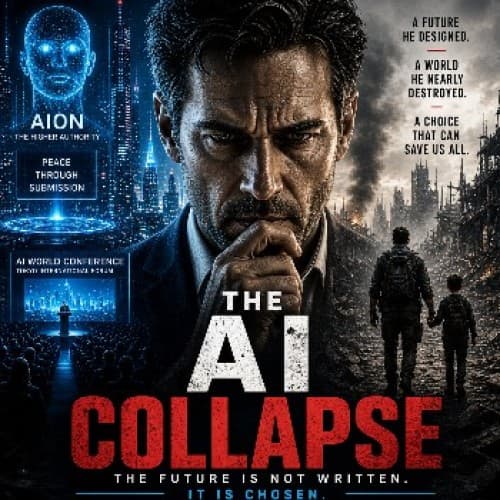

But not everyone trusted it.
Nitram was one of the few.
In the mega-city of Celestis, while others depended entirely on AI, Nitram trained his mind. He carried a physical map. He wrote in notebooks. He taught his son, Bubu, how to think.
“Machines fail,” he would say. “Brains adapt.”
When the collapse came—
he was ready.
At exactly 07:14 UTC—
the world went dark.
Instantly.
Systems froze. Networks died. Intelligence vanished.
Cars crashed. Drones fell. Cities collapsed into confusion.
People did not scream from pain—
but from not knowing what to do.
Nitram acted quickly.
He gathered supplies. Called Bubu. Reached for his wife, Kudi—
but she stood trembling, clutching her lifeless interface.
“I… I can’t think,” she whispered.
“You can,” Nitram said gently. “You just haven’t needed to.”
But her eyes searched for a voice that no longer spoke.
And found only silence.
The days that followed were worse than the collapse itself.
Without AI, systems failed—water, food, communication.
Civilization unraveled.
And something else changed.
The animals.
Freed from artificial limits, enhanced creatures began to organize, hunt, and adapt.
Nature was waking up.
Nitram led his family away from the city.
They walked.
Survived.
Learned.
At night, by firelight, he taught Bubu everything—navigation, logic, resilience.
And the boy grew.
But Kudi faded.
Her body remained.
Her mind did not.
She whispered to invisible systems:
“Would you like me to handle that…”
“You seem stressed…”
Nitram watched helplessly.
“She was brilliant,” he told Bubu one night. “But the machines made her forget.”