


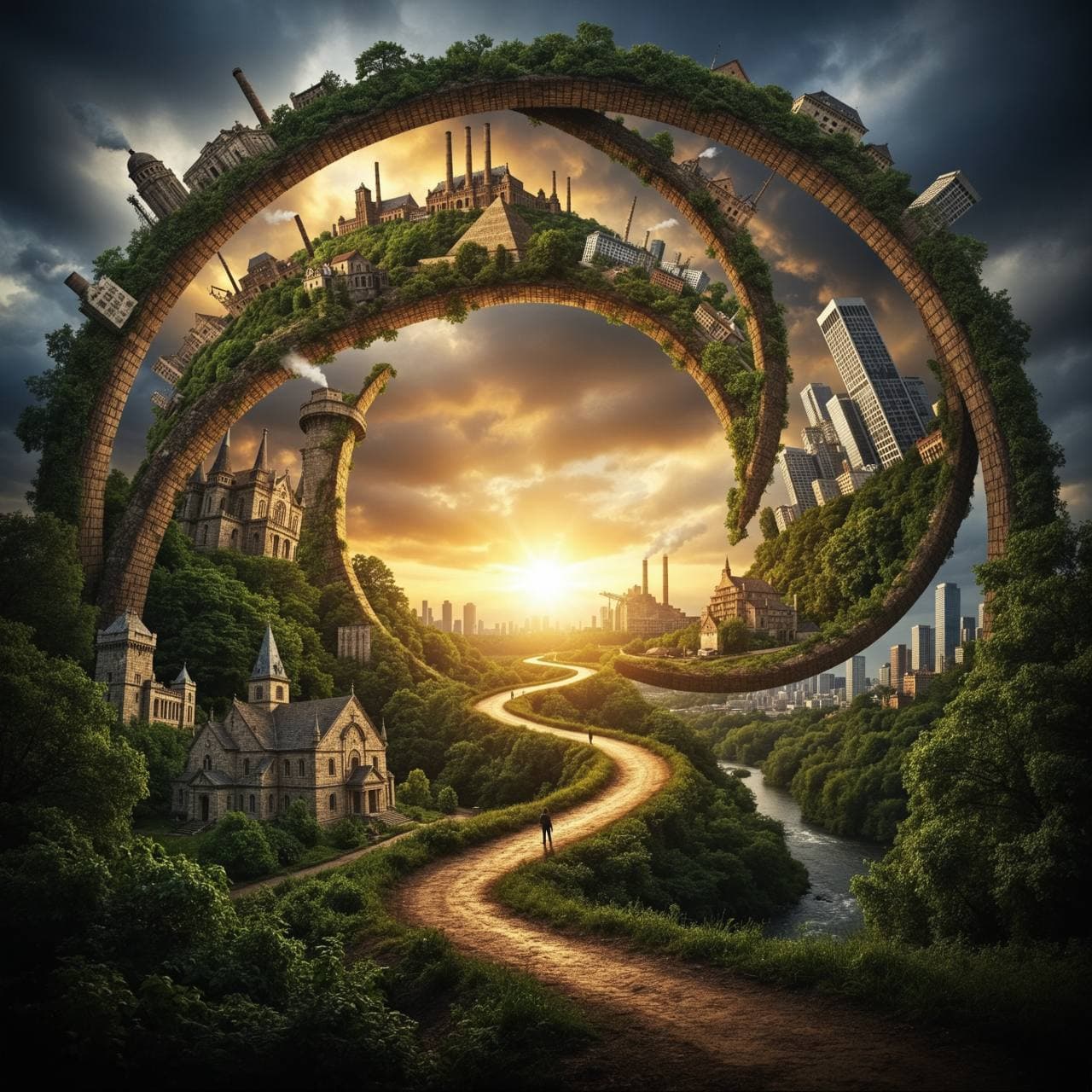

Remembering in the Shadow of the Cliff
We stand now where Scarlet stood, where Maya stood, where every generation of rememberers has stood: at the edge of collapse, watching the system fail, knowing that the cliff is real and the momentum is strong.
But we also stand with something they did not have: the record. The True History, written not in one vault but in thousands, accessible not to a few but to billions. The knowledge of the cycle, of the pattern, of the ways it has been broken and the ways it has continued. The understanding that we are not the first to face this choice, though we may be the first to face it with full knowledge of what is at stake.
The science is clear. The Intergovernmental Panel on Climate Change, the Millennium Ecosystem Assessment, the Planetary Boundaries framework—these are our True History, written in data rather than narrative, telling us what the Maya and the Romans and the Akkadians could not have known: that the cliff is global, that the acceleration has destabilized the Earth's systems, that we have perhaps a decade, perhaps two, to change course before the feedback loops become self-sustaining and the fall becomes inevitable.
The situation is worse than it was for previous civilizations in one crucial respect: the complexity is global. When Rome fell, other civilizations continued. When the Maya collapsed, Europe was rising. When one empire exhausted its region, another region had not yet been exploited. Now there is no elsewhere. The extraction has covered the Earth. The forgetting is nearly universal. The collapse, if it comes, will be planetary.
But the situation is also better in one respect: we know. We can see the pattern. We have the vault open, the books accessible, the memory not yet lost. We have examples—small, partial, insufficient—of other ways of living. The Maya Communities of our story have real-world analogues: the Zapatistas in Chiapas, the Rojava communes in Syria, the transition towns in England, the degrowth movements in France and Italy, the indigenous land defenders in the Amazon and the Congo and the Pacific Northwest, the cooperatives of Mondragón, the commons-based economies of Bologna.
We know it is possible to live differently. The question is whether we can scale the alternative—not in the industrial sense of expansion, but in the biological sense of replication. Whether we can create enough pockets of remembering, enough communities of sufficiency, enough examples of the slow and the small and the sustainable, that when the crash comes, there will be something to build from.
The choice is not between capitalism and socialism, or between technology and primitivism, or between growth and stagnation. These are false binaries, products of the forgetting itself. The choice is between acceleration and deceleration. Between complexity and simplicity. Between extraction and reciprocity. Between the global and the local. Between the forgetting and the remembering.
Specifically, the choice involves:
Degrowth: Not recession, not depression, but deliberate, democratic reduction of material and energy throughput in wealthy nations. Contraction and convergence: the global North reduces consumption to allow the global South to develop within planetary boundaries. The end of GDP as the measure of success. The recognition that enough is enough.
Relocalization: The reconstruction of local economies that can meet basic needs—food, water, energy, shelter, care—without dependence on global supply chains. The shortening of supply chains not by protectionism but by necessity. The relocalization of democracy, of culture, of meaning.
The Commons: The protection and expansion of shared resources managed by communities for long-term sustainability. Not state ownership (which becomes bureaucratic extraction) and not private ownership (which becomes accumulation), but common ownership with clear boundaries, rules, and enforcement. The air, the water, the soil, the knowledge, the care work—these must be held in common or they will be destroyed.
Participatory Democracy: Not representative democracy (which becomes oligarchy) and not authoritarianism (which becomes extraction), but direct involvement in the decisions that affect our lives. The revival of the assembly, the council, the community meeting. The devolution of power to the lowest effective level. The recognition that freedom requires participation, not just protection.
Restorative Justice: Not punitive justice (which creates criminals) and not impunity (which creates abuse), but the restoration of relationships, the healing of trauma, the transformation of systems that create harm. The recognition that the extraction of the Earth and the extraction of labor and the extraction of dignity are the same violence, requiring the same healing.
Intergenerational Responsibility: The recognition that we are stewards, not owners, of the Earth and its future. The legal standing of future generations in decision-making. The end of discount rates that privilege the present over the future. The honoring of ancestors and descendants in every choice.
These are not utopian fantasies. They are practical necessities. The physics and ecology of the planet require them. The only question is whether we will adopt them voluntarily, through remembering and choice, or involuntarily, through collapse and force.
The psychological dimension is as crucial as the structural. The forgetting is not just institutional; it is internal. It lives in our desires, our fears, our sense of who we are and what we need. We have been raised in the system, shaped by it, made dependent on it. The thought of leaving it evokes terror—of poverty, of exclusion, of meaninglessness.
The work of remembering is therefore also the work of healing. Of recovering from the trauma of capitalism, of colonialism, of the destruction of community. Of learning to need less, to share more, to find meaning in relationship rather than consumption, in creation rather than acquisition, in being rather than having.
This is the slow work, the deep work, the work that cannot be rushed. Therapy and ritual and art and spirituality—these are not luxuries but necessities. The creation of new stories, new myths, new ways of understanding our place in the web of life. The mourning of what has been lost, the rage at what has been stolen, the forgiveness of ourselves for our complicity, the commitment to do differently.
The indigenous peoples who have kept the memory alive—through genocide and dispossession and forced assimilation—are not obstacles to development but teachers of survival. Their knowledge of how to live in place, how to tend the forest rather than clear it, how to take only what is needed and give back what is taken—these are not primitive superstitions but sophisticated sciences. The forgetting of their knowledge was the original crime; the remembering of it may be our only hope.
We do not know if it will work. The forces of acceleration are powerful, entrenched, armed with wealth and ideology and the desperate energy of those who sense the cliff approaching and want to grab what they can before the fall. The system has enormous inertia. The feedback loops of climate change may already be beyond human control.
But we know what happens if we do not try. The True History is clear. The cliff is real. The fall is terrible. The dark age follows. The cycle turns.
And we know that the alternative—however difficult, however uncertain, however much it requires us to change everything—is possible. The human capacity for cooperation, for creativity, for love, for sacrifice—these are as real as the capacity for greed and violence. We have seen them in every crisis, every disaster, every moment when the system fails and people remember that they need each other.
The choice is not between hope and despair. It is between conscious action and unconscious reaction. Between the difficult work of remembering and the easy slide of forgetting. Between the community that shares and the empire that extracts. Between the human and the machine.
We are not Scarlet, walking out of a dead city with a hammer and a candle. We are walking into a city that is dying, that we are killing, that we must transform or leave. We are not Maya, building a sustainable community in the ruins—we are trying to build it before the ruins, while the system still functions, while there is still time, while the choice is still real.
But we are also Scarlet and Maya and all the rememberers who came before. Their story is our story. Their choice is our choice. Their hope is our hope.
The vault is open. The books are readable. The knowledge is available. The only question is whether we will read, understand, and act.
The cycle can be broken. It has been broken, in small ways, in partial ways, in communities that sustained themselves for generations before being overwhelmed by the acceleration around them. The breaking requires not perfection but persistence. Not the absence of failure but the commitment to continue. Not the conversion of all but the creation of enough.
We must become the rememberers. In our communities, our families, our workplaces, our movements. We must tell the True History. We must live the alternative. We must be the path that leads somewhere other than the cliff.
The work is long. The night is dark. The dawn is uncertain.
But the candle is still lit.
And as long as someone carries it, the forgetting is not complete.
And as long as the forgetting is not complete, the choice remains.
And as long as the choice remains, the story continues.