



That was six months ago.
Bob and I go to baseball games now. He still wears his Oura ring, but he checks it less. Last week, he ate a nacho helmet. Do you know what a nacho helmet is? It's a plastic baseball helmet filled with chips and cheese and jalapeños and probably seventeen different chemicals that would make Dave the barista weep into his mushroom blend while calculating the inflammatory response.
Bob's HRV probably suffered. His glucose definitely spiked. His "recovery score" probably looked like the stock market crash of 1929. But you know what? He laughed. He laughed so hard he spilled cheese on his shirt, and then he laughed more because we were remembering that time in 1989 when we tried to fix his transmission with duct tape and hope and a copy of the Yellow Pages, back when you could still find a mechanic by looking in a big yellow book instead of asking an algorithm.
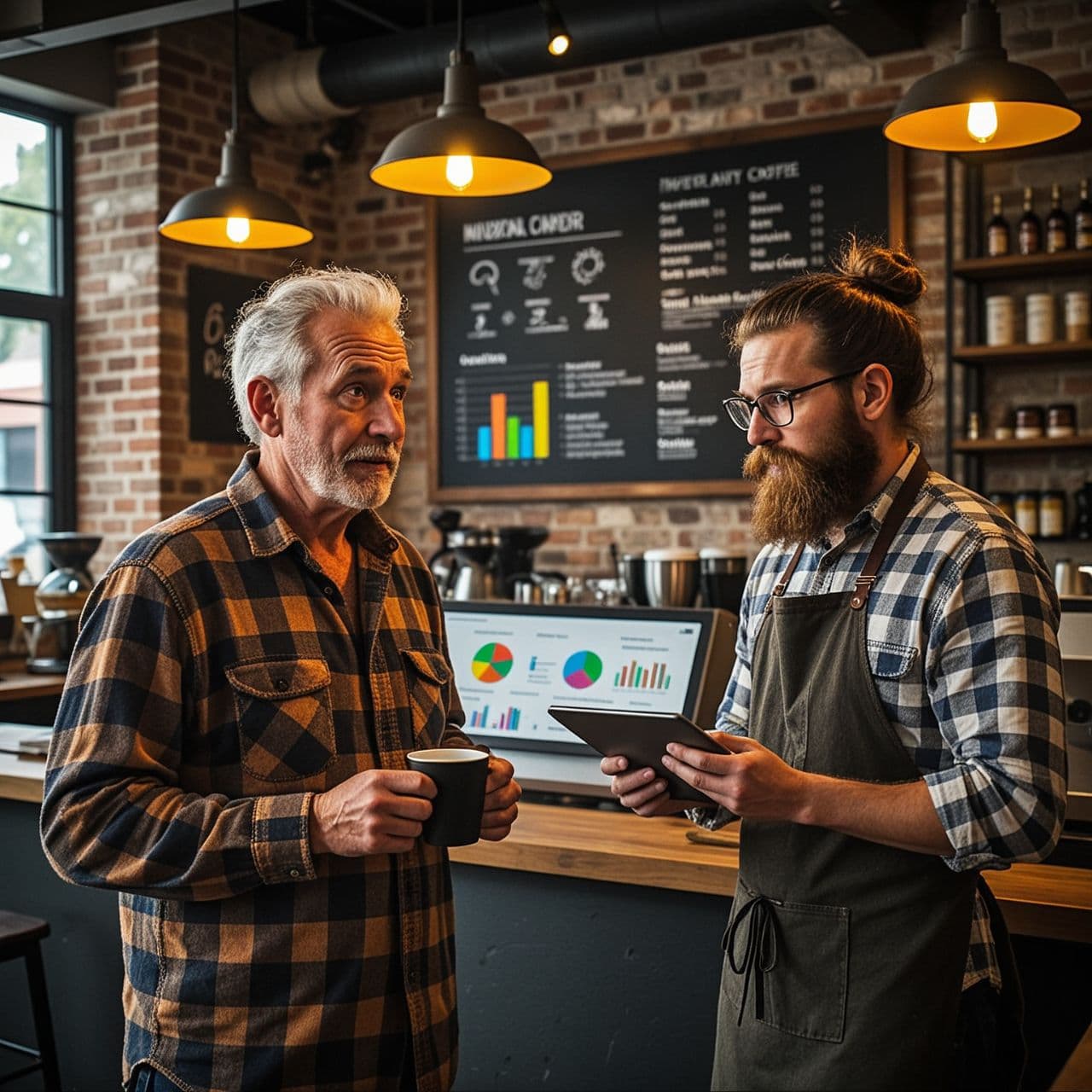
I went back to The Bean Counter last Tuesday. Dave was there, still curating, still optimizing, still trying to save the world one spreadsheet cell at a time.
"Hey!" he said, recognizing me. "I was just thinking about you. I finished my actuarial studies. Check this out—" he pulled up his tablet, which had more processing power than the spacecraft that landed on the moon "—I've built a model that calculates the exact optimal moment to do anything. When to drink coffee for maximum productivity. When to exercise for maximum longevity. When to socialize for maximum emotional return on investment. When to sleep for optimal cellular repair. It's comprehensive. It's predictive. It's—"
"It's terrifying, Dave," I said.
He paused. "Yeah," he admitted. "It is a little terrifying. I ran it on myself last week. It says I should have started saving for retirement when I was twelve. It says I'm already behind on my life goals. It says—" he looked genuinely sad for a moment "—it says I should probably call my mom more, but only between 3:00 and 4:00 PM on Tuesdays for maximum relationship efficiency."
"Dave," I said, "do you know what I think about when I think about the best moments of my life?"
He shook his head. His beard wobbled.
"I think about getting lost. I think about wrong turns. I think about the time I tried to cook Thanksgiving dinner and set off the smoke alarm and had to order pizza and it was the best Thanksgiving ever because nothing went according to plan. I think about the unoptimized moments, Dave. The messy ones. The ones that don't fit in spreadsheets."
Dave looked at his tablet. He looked at me. He looked at the spreadsheet with my name on it, with all those cells calculating my remaining days, my optimal choices, my probability distributions.
"You know what?" he said. "Screw it. Large black coffee. $2.50. No optimization. No life expectancy calculations. No mushroom blend. Just... coffee."
"Thank you, Dave."
"But—" he held up a finger, because Dave can't help himself, Dave is a spreadsheet guy down to his bones "—can I just say? If you did want to talk about your legacy planning, I still know that guy. He does blockchain wills. Very decentralized. Very secure. Your descendants will access your assets through cryptographic keys that—"
"Dave."
"Right. Just coffee. Got it."
I paid in cash. Dave didn't even flinch this time. Progress.
I sat by the window. I watched people walk by, most of them looking at their phones, their wrists, their various devices telling them how they were doing, how long they had left, whether this moment was optimal, whether they were winning at life according to the algorithm.
And I thought: they're not wrong. The world has changed. We know so much more now about how to live long, healthy lives. The data is real. The science is sound. Dave's spreadsheet isn't lying to me. Dr. Johnson's monitors aren't making things up. Bob's HRV is probably actually important, in some cosmic sense.
But the secret—the thing the spreadsheet guys will never put in their cells, the thing that doesn't fit in any algorithm, the thing that can't be quantified or tracked or optimized—is that life isn't in the optimization. It's in the waste. The lost hours. The wrong turns. The nacho helmets. The rust holes in the floor of a Chevy Nova. The moments you can't quantify because you were too busy living to measure.
I'm going to die. I know that now more than I ever did. Dr. Johnson's bell curve is real, even if I don't want to look at it. Dave's calculations aren't wrong. I have a finite number of days, a finite number of hours, a finite number of coffees left to drink, a finite number of baseball games left to watch with Bob.
But here's what I'm choosing:
I'm choosing to not know the number.
I'm choosing to drink the coffee because it's Tuesday and I'm tired and the sun is coming up. I'm choosing to get lost on purpose. I'm choosing to waste time with friends who remember when maps were made of paper and phones were attached to walls and you could fix a transmission with duct tape and a prayer. I'm choosing to be unoptimized, unquantified, unmeasured, un-tracked, and absolutely, defiantly alive.
I'm choosing to forget, as often as I can, that there's a spreadsheet somewhere with my name on it.
Because the thing about being a 60s baby—the thing they can never take from us, no matter how many apps they invent or algorithms they write or wearables they sell us—is that we remember.
We remember when life was analog. When time was just time, not a resource to be managed. When a handshake was enough. When you could buy a house with a job that didn't require a coding bootcamp. When love was something you discovered, not something you swiped for. When getting lost was an adventure, not a bug to be fixed by GPS. When you could eat a nacho helmet without calculating the cost to your healthspan.
We remember, and remembering is a kind of resistance. Remembering is a revolution. Remembering is the only optimization that matters.
So here's to us, the unoptimized. The unquantified. The ones who still use cash sometimes, who still get lost on purpose, who still believe that the best moments are the ones you can't plan for, can't track, can't improve upon, can't put in a spreadsheet.
Here's to the spreadsheet guys, too. May their HRV be high and their data be clean and their mushroom coffee be exactly the right temperature.
But mostly, here's to the coffee. Black. Large. Unoptimized.
And absolutely perfect.
Just like the days we have left, however many they are.
Now go get lost on purpose. You might find something.