


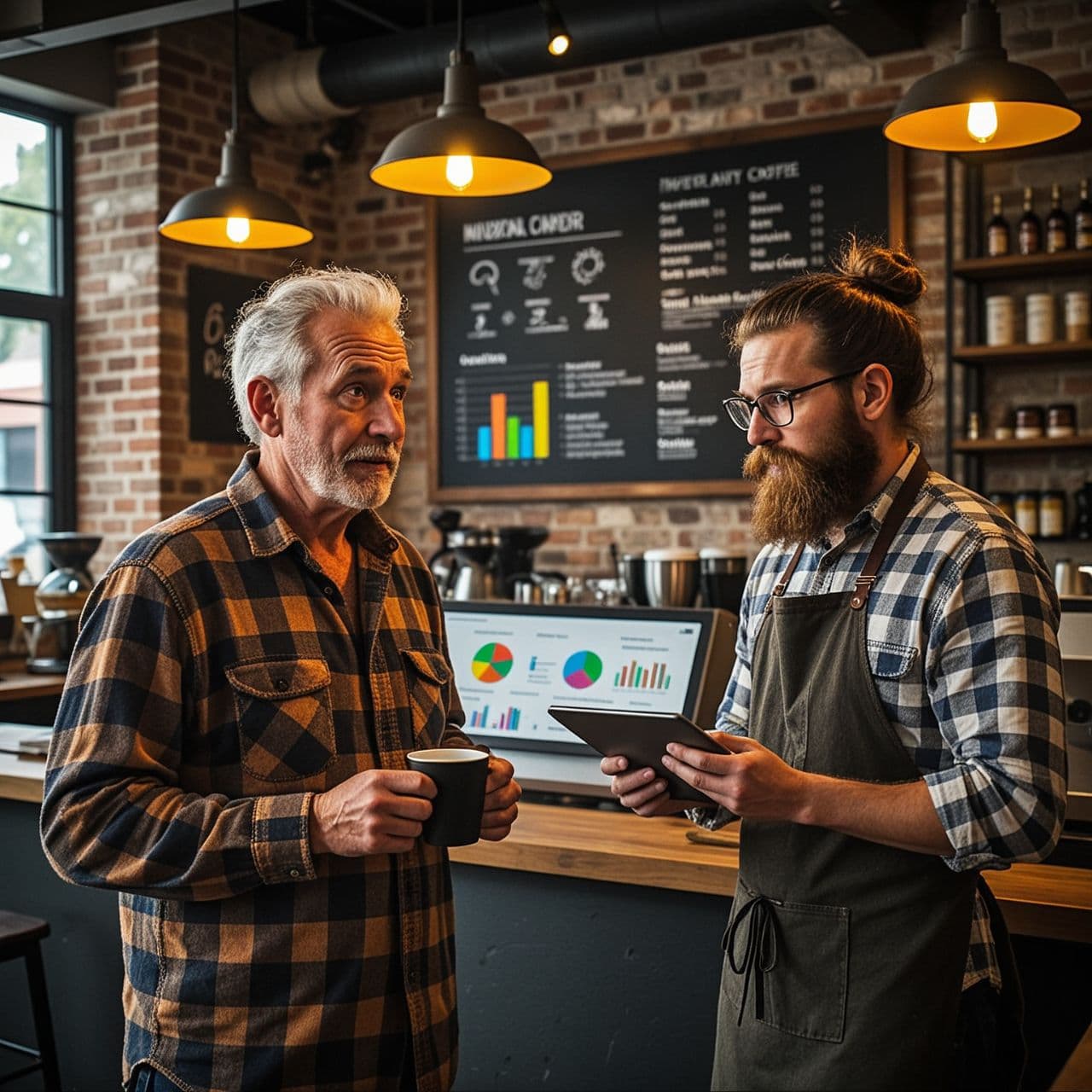

I just wanted a coffee.
Not a personalized consumer experience. Not a data-driven hydration solution. Not a mindful caffeine ritual optimized for cortisol management. Just a cup of hot brown liquid to convince my eyelids that morning was, in fact, a concept worth participating in.
But Dave was behind the counter.
You know Dave. Every coffee shop has a Dave now. He's twenty-six, has a beard that looks like it required zoning permits and possibly EPA approval, and genuinely believes that his part-time job as a barista is actually fieldwork for his eventual TED Talk about "Disrupting the Caffeine Economy Through Blockchain-Enabled Bean Provenance."
"Welcome to The Bean Counter," Dave said, though the sign clearly read "Morning Brew." He'd renamed it in his head. Probably in an app, too. "I'm Dave. I'll be your coffee curator today."
"I'll have a large black coffee," I said. In my day, this was a complete sentence. You could go to a diner in 1987, say "coffee," and someone would pour hot liquid into a mug that had probably been through three presidential administrations without being properly washed, and that was it. Transaction complete. Dignity intact.
Dave's face contorted like I'd asked him to solve Fermat's Last Theorem using only interpretive dance and a slide rule. "Large... black... coffee?" He said it the way a priest might say "ritual human sacrifice... but make it casual."
"Yes. Large. Black. Coffee. The thing with the beans and the water. Like they had in the Old Testament."
"Right, right." Dave pulled out an iPad. Not a notepad. An iPad. The kind of device that, in my youth, would have been considered witchcraft or at least evidence of alien intervention. "So, when you say 'large,' are we talking volume, emotional significance, or existential weight? Because I can do a 16-ounce, but that's really just a starting point for the conversation we need to have about your hydration goals and your relationship with productivity."
"I don't have hydration goals, Dave. I have a mouth and a caffeine addiction that predates your parents' wedding. Possibly your parents' existence. I started drinking coffee when Reagan was president and we thought the biggest threat to America was Sylvester Stallone making Rhinestone with Dolly Parton."
Dave nodded sympathetically, the way you nod at a confused grandparent who thinks the television is a window and the phone is witchcraft. "I get it. You're from the analog generation. You like things simple. But here's the thing, my dude—" (I'm fifty-seven. I haven't been anyone's "dude" since Reagan's second term, and even then it was questionable.) "—we're not just selling coffee anymore. We're selling optimization. We're selling potential. We're selling the scientifically-proven-best-version-of-your-morning."
He turned the iPad around. On the screen was a spreadsheet.
I wish I were making this up. I wish this was one of those "back in my day" stories that gets exaggerated at Thanksgiving until Grandpa claims he walked uphill both ways in the snow to buy a coffee that cost a nickel and came with free psychotherapy. But no. There was an actual spreadsheet. It had my name on it. It had columns. It had formulas. There was a cell with conditional formatting that was literally blinking red.
"So I've got your basic profile here," Dave continued, tapping at columns I couldn't read without my reading glasses, which were in my car, which was parked three blocks away because the parking app required a password reset that sent a code to a phone number I stopped using in 2019 when I got divorced and my wife got the phone plan and I got the existential dread. "Born 1967, which puts you at... whoa, fifty-seven. Okay, so according to the actuarial tables I've been studying—"
"You're studying actuarial tables?"
"Oh, totally. I'm minoring in Data-Driven Existentialism at the New School. Super fascinating stuff. Did you know that every decision you make before 9 AM impacts your cortisol curve for the entire day? It's wild. So, male, born 1967, current life expectancy is roughly 84.2 years, but that's assuming you don't engage in high-risk behaviors."
"I want coffee, Dave. Not BASE jumping."
"Caffeine is a risk factor, though. Increases cortisol, impacts sleep architecture, cardiovascular stress, potential for jitter-related accidents. Each cup costs you roughly 0.0004 years of life expectancy." He typed something with the urgency of a bomb technician. The spreadsheet updated with a cheerful little chime that sounded like a fairy drowning in a latte. "But here's the good news! If you switch to our adaptogenic mushroom blend with oat milk and collagen peptides, I can get you back 0.0002 of those years. Plus, the mushrooms are really grounding. They're like therapy, but you can drink them."
I stared at him. Behind Dave, a line was forming. A woman in yoga pants that cost more than my first car was checking her watch, which was probably also calculating her VO2 max and sending passive-aggressive notifications to her liver. A guy with a man-bun that defied several laws of physics was scrolling through what appeared to be a cryptocurrency portfolio while waiting for his order, occasionally muttering "HODL" to himself like a mantra. Nobody seemed alarmed that the barista was currently running death calculations on a tablet.
"Let me get this straight," I said slowly. "You can't just sell me coffee. You have to sell me... immortality?"
"Well, not immortality," Dave corrected, as if this were a reasonable clarification, like distinguishing between whole milk and two percent. "That's a separate app. $4.99 a month, syncs with your Oura ring and your ancestry.com profile. But we can definitely optimize your remaining time. Speaking of which—" he checked another column, his eyes widening slightly "—you've got approximately 9,892 days left, statistically speaking. That's 237,408 hours. If you sleep eight hours a night, which you probably don't because you're fifty-seven and that's when sleep apparently becomes a competitive sport, that's 158,272 waking hours. Now, if we assume a standard coffee preparation and consumption time of twelve minutes, and you drink two cups per day—"
"Dave."
"—that's 24 minutes daily, which over your remaining lifespan equals—"
"Dave."
He looked up, blinking his wide, innocent, twenty-six-year-old eyes that had never known the specific trauma of rewinding a cassette tape with a pencil.
"I just want to pay for my coffee," I said. "With money. That I earned. In the 1990s, when a handshake was a contract and you could buy a house with a job that didn't require a coding bootcamp and the only 'cloud' we worried about was whether it might rain on our barbecue."
Dave's expression softened. He leaned in conspiratorially, his beard nearly dipping into the milk steamer. "You know what? I get it. My dad's your age. He still uses checks. Like, paper ones. Writes words on them with a pen. It's actually kind of beautiful, in a tragic, 'we're going to lose him to the past' kind of way."
He punched something into the iPad. The spreadsheet disappeared, replaced by a simple payment screen that looked almost naked in its simplicity. "Large black coffee. $2.50. No optimization. No life expectancy calculations. Just... coffee."
"Thank you, Dave."
"But—" he held up a finger as I reached for my wallet, which was genuine leather and had been manufactured in a country I could identify on a map "—can I just say? If you did want to talk about your legacy planning, I know a guy. He does blockchain wills. Very decentralized. Very secure. Your descendants will be able to access your assets through a series of cryptographic keys that—"
I paid in cash. Actual paper money with presidents on it. Dave stared at the bills like I'd handed him puka shells, a flint knife, and instructions for building a sundial.
"What's this?" he asked.
"Money, Dave. Legal tender. It doesn't need to be charged."
He held it up to the light, checking for the watermark the way his generation checks for gluten.