


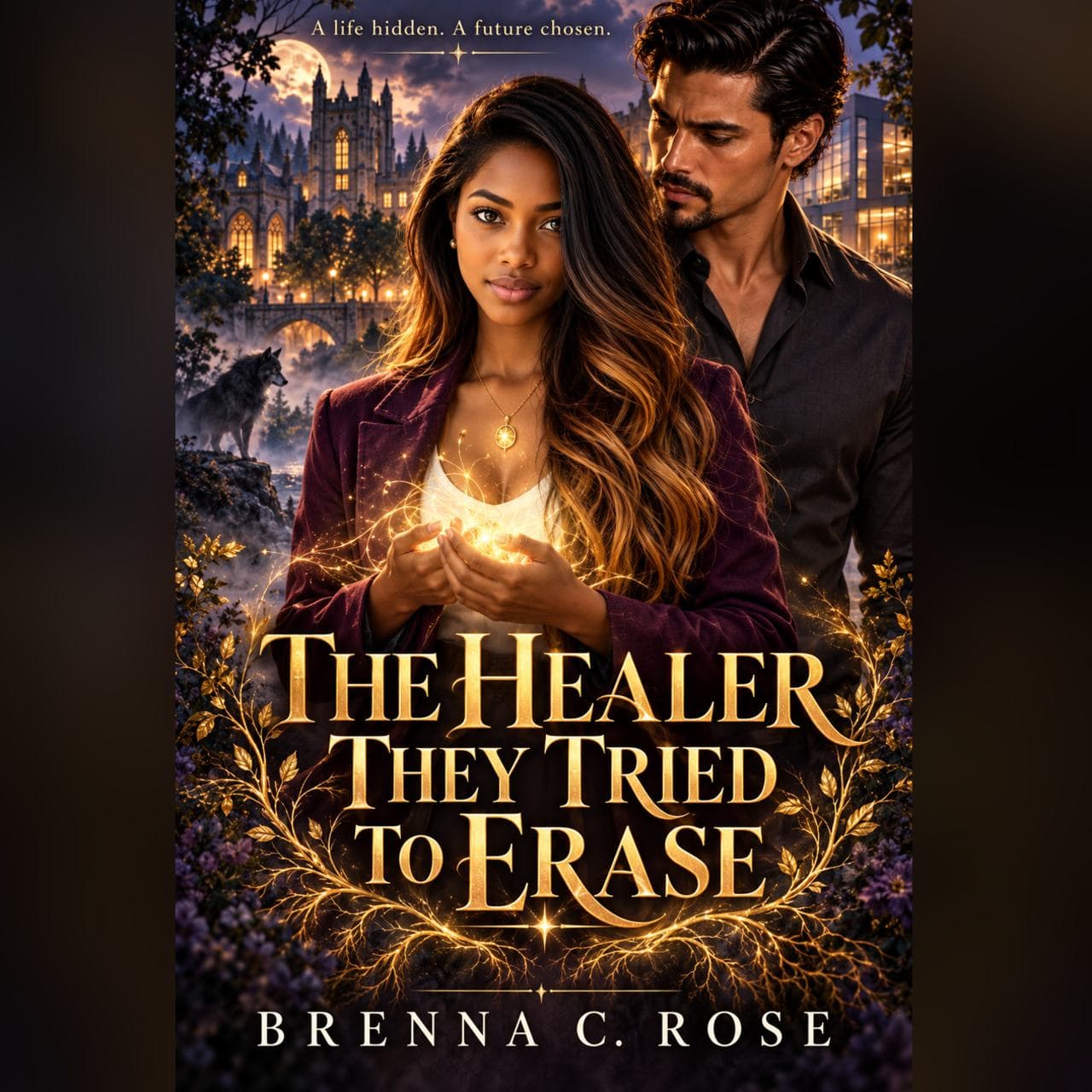

Gemma Bennett had been eighteen for six days when the charm finally opened.
She was sitting cross-legged on her bedroom floor, surrounded by university paperwork and an unreasonable number of charging cables. Downstairs, Elijah and Elias were arguing about whether a miniature refrigerator counted as essential medical equipment.
“She’s studying medicine,” Elijah said through the open stairwell. “She needs somewhere to keep things cold.”
“Food, Elijah. The word you’re looking for is food.”
Gemma smiled and pulled another sheet from the box beneath her desk.
The cardboard edge caught the side of her finger.
“Oh, come on.”
A bead of blood rose from the cut. Before she reached for a tissue, familiar warmth gathered beneath her skin. The wound drew closed, leaving a red line that faded while she watched.
That much was ordinary.
The pendant lying against her collarbone becoming hot enough to startle her was not.
She lifted it away from her white tank top.
Her mother had put the charm on a chain when Gemma was seven. Before that, it had lived in a little velvet pouch among her baby things. Gemma knew the story: a blanket, a clinic doorway, a storm. Her parents had never pretended she had come into their lives another way.
But the charm itself had refused every attempt to explain it.
Jewelers had examined it. Pack specialists had frowned over it. Elias had once proposed an industrial laser and been banned from participating further.
Now a thin line appeared across the gold.
Gemma stopped breathing.
She pressed her thumb to the seam.
The charm opened into two shallow halves.
Light collected between them, delicate as a soap bubble. Inside it hung a symbol: three branching lines curved around an empty center.
A woman’s face appeared.
Only part of it. One cheek. A dark eye. The edge of a mouth trembling with the effort of speaking.
“If you are hearing this,” the woman said, “the concealment has ended.”
Gemma’s fingers tightened around the chain.
“Wait.”
The image fractured.
“You must - ”
A sound cut across the recording. Metal struck something hard. The woman looked away, terror changing her expression.
Then the light collapsed.
Gemma sat motionless.
Someone downstairs dropped something heavy.
“That was the floor,” Elias announced. “In case anybody asks what broke.”
Gemma stared into the open charm.
Tiny marks covered its inner surface. Some looked like letters. Others resembled the diagrams in her introductory anatomy text, branching vessels that divided and returned to one another.
She touched them.
Nothing.
“Gem?”
Her mother’s footsteps sounded on the stairs.
Gemma closed the charm so quickly that the little edges pinched her thumb.
Naomi appeared carrying folded towels, her dark curls pinned loosely at the back of her head.
“Have you packed your prescription card?”
“It’s on my phone.”
“And if your phone dies?”
“Then I’ll experience the collapse of civilization with everybody else.”
Her mother gave her a look.
“Printed copy. Front pocket.” Gemma pointed at her bag.
Naomi set the towels on the bed. “Good.”
She glanced at the papers scattered across the floor, then at Gemma’s face.
“You all right?”
The answer rose automatically.
Yes.
Then the woman’s frightened eye returned to her.
Gemma looked down at the charm in her hand. If she showed Naomi, her father would know within minutes. Elijah would begin checking doors. Elias would search everything he could access and several things he could not. By dinner, the small piece of gold would be in someone else’s custody.
She wanted one night with it. One night to look without explaining what she hoped to find.
“Just nervous,” she said.
Naomi sat on the edge of the bed.
“About leaving?”
Gemma nodded. It was true enough to make her uncomfortable.
“You know you can be excited and still miss us.”
“I haven’t left yet.”
“I’m getting a head start.”
Gemma leaned against her mother’s knee. Naomi’s fingers moved through the dark roots of her hair, separating a caramel-tipped strand caught beneath the chain.
For a moment, telling her seemed easy.
Then Elijah appeared in the doorway holding a compact black flashlight.
“Put this in your bag.”
Gemma looked up. “Does the university not have electricity?”
“Batteries fail. Buildings lose power.”
“Apparently we’re sending you to a bunker,” Naomi said.
Elijah ignored her. At twenty-four, he wore his pack-response uniform as if he had been born mildly disappointed in everybody’s emergency preparedness.
Elias leaned around him.
“I talked him out of the door alarm.”
“You did not talk me out of anything.”
“You’re welcome,” Elias told Gemma.
She accepted the flashlight. “Thank you. Both of you. Please stop improving my survival chances.”
They left her alone eventually.
That night, Gemma reopened the charm beneath her desk lamp. The recording did not play again. She took photographs of the inscription, but every image showed a smooth gold interior.
She tried three angles, two lighting settings, and Elias’s old tablet.
Nothing.
At last she copied the marks by hand into the back of a notebook.
At the top of the page, she wrote a single question.
Concealment from whom?
•••
Briarhaven University looked too expensive to be trusted.
That was Elias’s assessment as they turned beneath the iron entrance arch two mornings later.
Beyond it, old brick buildings faced a broad pedestrian green. A glass research tower rose behind them, reflecting the wooded ridge. Students rolled suitcases past charging stations and digital signs welcoming the incoming class of 2026.
Gemma lowered the passenger window.
Coffee. Warm pavement. Cut grass. Beneath it all, the familiar layered scents of a shifter territory - wolves, rain in distant soil, old stone marked by generations of passing hands.
Her wolf stirred with interest.
She had shifted for the first time at sixteen. Since then, the animal presence had settled into her life like an instinct with opinions. Today, it approved of the trees and distrusted the traffic.
“Your accommodation is north-facing,” Elijah said from the back seat. “The evacuation point is - ”
“On the welcome app,” Gemma finished.
“Which you haven’t opened.”
She turned around. “How would you know that?”
Elias became fascinated by the road.
“Elias.”
“I might have helped set up your account.”
“You helped set up my account while I was sitting beside you.”
“And it was a beautiful family experience.”
Gemma held out her hand. “Phone.”
“I’m driving.”
“Then park.”
By the time they reached her residence hall, her password had changed, Elias had apologized with only moderate theatrical suffering, and Elijah had carried three boxes upstairs without once using the elevator.
Gemma watched him check the window latch.
“It opens,” she said. “That’s generally considered a feature.”
“It opens onto a roof.”
“Excellent. If the stairs fail, I’ll use the flashlight.”
He gave her a tired look, then reached into the top box and placed a familiar framed photograph on the desk.
Gemma at twelve, front teeth uneven, holding a science-fair ribbon. Naomi laughing. Thomas looking solemn until one noticed the glitter stuck to his cheek. Her brothers on either side of her, both pretending they had not helped build the model heart.
Her throat tightened.
Elijah noticed. Of course he did.
“You don’t have to prove anything this week,” he said quietly.
“I know.”
“Call if you need us.”
“I know that too.”
He hugged her then, hard enough to make her complain, and she held on longer than she intended.
They were still disentangling themselves when someone knocked on the open door.
“Please tell me this is room three-fourteen. If that lift has lied to me again, we’re going to have a conversation.”
A young Black woman stood behind a suitcase with one temperamental wheel. She wore wide-legged black jeans, a fitted rust-colored top, and gold hoops that caught the corridor light. Her braids were gathered high, the ends brushing a canvas bag covered in tiny embroidered symbols.
She examined Elijah, the boxes, and the window he had checked twice.
“Am I interrupting a move-in or a hostage negotiation?”
Gemma laughed before she could stop herself.
“Move-in. Mostly.”
“Good. I’m Brenda. Housing says we share a bathroom, a common room, and responsibility for whatever that smell is.”
“Fresh paint,” Elias said from the hall.
“Optimistic of you.”
Her suitcase wheel caught on the threshold. Brenda sighed, crouched, and drew a short line on its bracket with a silver paint pen. She tapped it twice.
The wheel straightened.
Gemma felt a small change in the air, like static lifting from a sleeve.
“You’re a mage.”
“Since birth. Officially useful since my aunt got tired of paying appliance repair bills.” Brenda rolled the case inside. “That’ll hold until I can replace the bracket. Magic is not a warranty.”
Elijah watched the silver mark.
“Residence wards prohibit unregistered structural alterations.”
Brenda looked at the suitcase. “Then the building is safe from my luggage.”
Elias turned away, shoulders moving.
“What are you studying?” Gemma asked, before Elijah could find another regulation.
“Applied ward engineering. Medical stabilization elective, if they ever approve my timetable. I want to design wards for public clinics that don’t cost more than the clinic.”
“Medical apprenticeship.” Gemma pointed to herself.
“Excellent. You fix people, I keep the ceiling from falling on them.”
Elijah’s radio interrupted. He stepped into the hall to answer it, and Elias followed with the last empty box.
Brenda waited until they were out of earshot.
“Are they always like that?”
“They’re being restrained.”
“My condolences.”
Gemma leaned against the desk. “Where are you from?”
“Eastbridge. Above my aunt’s repair shop, opposite a bus stop that apparently needed announcements all night. This place is so quiet I can hear myself reconsidering my decisions.”
Her gaze settled on the family photograph. She studied it without touching.
“They love you,” she said.
Gemma looked toward the hall. “They do.”
“That helps. Still doesn’t give them ownership of the window.”
By the time their families had gone, Brenda had located the least expensive grocery delivery, discovered that neither of them owned a saucepan, and asked permission before drawing a temporary anti-rattle mark on their shared desk fan.
That evening, they ate takeout on the common-room floor. Gemma learned that Brenda was nineteen, had worked a year in the repair shop before university, and could identify cheap wardwork by the headache it gave her.
Brenda learned that Gemma liked her tea sweet, missed her mother already, and laughed hardest when she tried not to.
Neither of them called it friendship yet.
Gemma put Brenda’s number in her favorites anyway.
•••
Her first medical-foundations lecture began the following morning in a room smelling of fresh paint and old books.
Dr. Imani Mercer stood beside the display wall, silver threading her close-cropped hair. Gemma knew her as the physician who had assessed her as a baby and treated every childhood fever afterward. Seeing her beneath the university crest made Gemma sit straighter.
“You are entering a supervised apprenticeship,” Mercer told the room. “Some of you have healing gifts. Some do not. Every one of you will learn when your hands should stay in your pockets.”
A few students laughed.
“That wasn’t a joke.”
The laughter stopped.
Gemma liked her more every minute.
Mercer advanced the presentation. A diagram of accelerated tissue repair filled the screen. Beside it appeared a faded illustration from an older text: branching lines curved around an empty center.
Gemma’s pen stopped.
“Before modern classification,” Mercer said, “healing traditions used symbolic notation. We’ll discuss the historical systems later in the term.”
Gemma’s fingers moved to her pendant.
The lines were not identical. One branch bent the other way.
But they were close enough that she turned to the back of her notebook and covered her drawing with her palm.
Beside her, Brenda stopped doodling in the margin of her timetable. She had arrived breathless, triumphant about securing a place in the mixed-discipline foundations class.
Now her eyes moved from Gemma’s face to the hand covering her notebook.
She slid a small piece of paper across the desk.
Need to leave? I can ask a distracting question. I have several legitimate ones.
Gemma looked at her.
Brenda lifted one shoulder. No demand for an explanation. No attempt to pull the notebook closer.
Gemma wrote, Not yet. Thank you.
For the rest of the lecture, she heard very little. But she no longer felt quite as alone in the room.