


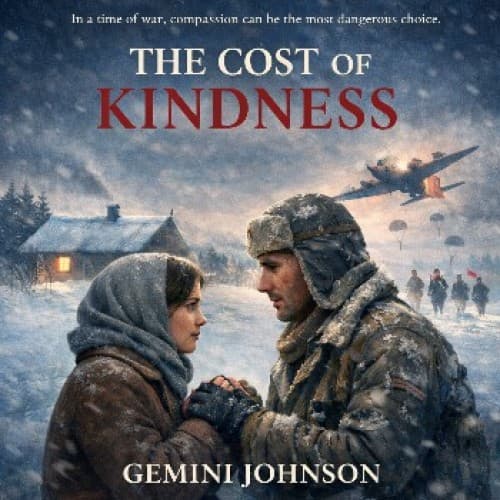

By the time spring reached the camp, it came not as mercy but as mud.
The snow withdrew in patches, exposing the earth beneath in long black wounds. Paths that had been hard and white for months turned first to slush, then to sucking trenches that pulled at boots and swallowed straw, ash, and anything dropped into them. Water dripped constantly from roofs and fences and the edges of watchtowers. The barracks smelled worse in thaw than in freeze. Damp lifted everything hidden in the boards—mold, sickness, old smoke, stale sweat, the sweet-rotten odor of straw too long used and never truly dried.
Yelena had thought winter might kill her cleanly.
Spring chose instead to wear her down.
By then she no longer counted time except in work details and ration lines. Morning whistle. Roll call. Labor. Soup. Labor again. Evening count. Bread. Darkness. The body narrowed itself around those points until there was not much else left in it. She had become light enough that climbing from the top bunk made her dizzy if she moved too fast. Her hands, once broad-palmed and capable, had become all knuckle and tendon, the skin over them chapped and gray. The dress issued to her hung loose at the chest and waist. Her hair, growing back unevenly after being cut at the rail holding point, lay in dark rough curls around her ears and nape. In the polished reflection of a barracks window after sunset she no longer resembled the girl who had hauled a wounded man from the snow. That girl seemed as distant as someone from a story told badly and long ago.
She did not know the war in any formal sense. News reached the camp in scraps, distorted by rumor, half-overheard from guards, or guessed from the rhythm of trains moving west and then back east with different cargo. But even prisoners could feel a war changing shape. The guards were shorter with their tempers. Supplies more uneven. Men came through the administrative buildings speaking not only Russian now but German, Polish, sometimes English, though she could rarely make out enough to understand. There were new faces in the camp, some in civilian rags, some in uniforms stripped of insignia, some so far gone that nationality seemed irrelevant.
The transfer came at dawn.
Her number was called with twelve others from Barracks Three and six from Barracks Two. No explanation. None needed. Transfers happened for labor quotas, for overcrowding, for paper reasons no prisoner ever saw. You stood when your number was called, held out your wrists if told, and went.
Yelena did not ask where.
They loaded them first onto a truck and then, hours later, into a freight car attached to a military train bound farther west. The car had once carried livestock. It still smelled of manure beneath the layered human odors now packed into it. There were slats high in the walls for air and a sliding door bolted from outside. Men and women traveled together in this one, too many for sitting, forced to sway with the motion and brace each other accidentally at every curve and jolt. A bucket in the corner served the whole car. No one looked directly at it unless they had to.
Yelena rode half-standing, shoulder wedged against a wall plank, one hand wrapped around the iron bracket beside the door. Her knees shook by the second day from weakness and the constant effort of remaining upright. The woman beside her—older, with a face collapsed inward by missing teeth—offered once to trade positions for an hour when she saw Yelena’s eyes darken with dizziness. Yelena shook her head. They were all too tired for generosity to survive often, and she would not spend one of the woman’s rare impulses if she could help it.
At stops they were given water and, once, a dipper of soup so thin it might have been warm weather rather than food.
The countryside changed by degrees beyond the slats.
Forests gave way to flatter land. Villages appeared more often, many damaged or abandoned, roofs gone in, church spires blackened, fields rutted by tracked vehicles. Roads bore more military movement now—columns, ambulances, guns, wagons, trucks in endless variations of mud and canvas. Smoke sat over everything. Not the domestic smoke of chimneys and cooking fires, but the broader dirtier hanging smoke of a continent worked over by artillery, engines, and men.
By the third day the train no longer moved in long confident stretches. It lurched, halted, backed, waited. Sometimes they would sit motionless for an hour while muffled concussions sounded from somewhere too near for comfort. Once aircraft passed overhead low enough that everyone in the car looked up reflexively though there was nothing to see but the roof planks and the vibration running through them.
Toward evening on the fourth day, guards opened the car and ordered them out at a rail junction little bigger than a wound in the landscape.
The station had been hit recently. One corner of the platform canopy lay splintered across the tracks. A freight office had lost most of its windows. Telegraph lines sagged. Men in mixed uniforms moved everywhere—Soviets, local railway workers, and a few uniforms Yelena did not recognize at all. Not German field gray exactly. Not Soviet. Her mind, dulled by hunger, took too long to fit them to memory.
The prisoners were herded into a warehouse beside the rail yard and made to sit on the floor under guard.
Cold had gone out of the world by then, but not comfortless weather. The floorboards were damp. Somewhere close by diesel burned thick. Gunfire sounded in the distance now in irregular bursts, not the steady far mutter of a front line but something nearer and more broken up, like fighting that had slipped loose from larger formations and was ricocheting through roads and sidings and villages without order.
A guard shouted at another in German.
Yelena lifted her head.
German.
The word passed through her not with fresh fear but with a kind of exhausted disbelief. The war had become so tangled by then that prisoners changed hands, trains were rerouted, camps emptied and refilled under collapsing administrations. She no longer understood who controlled what, only that control always arrived in boots.
The warehouse door slammed open an hour later. Another group of men entered, shouting over one another. One struck a prisoner with a rifle butt for standing too slowly. Another argued with the station clerk over papers. Somewhere outside an engine revved and then cut off.
Then came the sound she had not heard in months and recognized before the language itself resolved.
English.
Not the slow simple English Austin had made for her at the cottage table, but the fast hard English of men under strain, voices barked over movement and metal.
The guards heard it too.
Everything changed at once.
Orders. Running boots. A whistle. Someone threw open the side door of the warehouse and began shoving the prisoners toward it, not out of mercy but out of panic, as if clearing bodies from a room suddenly mattered more than containing them. Another guard shouted back in German. A shot cracked outside, close enough to punch plaster dust from the wall.
The prisoners bunched and stumbled.
Yelena tried to stand and her legs failed under her.
The floor came up hard against her knees and one palm. She stayed there for a stupid moment, staring at the wet dark marks her fingers made on the boards. Around her people were moving, cursing, crying out, shuffling toward whichever exit seemed least likely to draw a bullet. A woman stepped on the hem of her coat and nearly pulled it from her shoulders. Someone behind her fell. The room had become all boots and noise and the sour hot smell of fear.
Yelena got one foot under herself and reached for the nearest crate to pull upright.
Gunfire ripped across the yard outside.
Not distant now.
Close. Loud enough to flatten thought.
The warehouse door burst inward.
Cold daylight and smoke poured through the gap with three soldiers at its center, helmets low, rifles up, uniforms muddied and unfamiliar except that suddenly they were not unfamiliar at all.
American.
One of them shouted something she did not catch. Another moved left, covering the corner by the office door. The third swept his rifle across the room and froze at the sight of the prisoners.
“Jesus Christ,” he said.
The words struck her with the force of another life.
Yelena was no longer standing. She had slid back against a crate without feeling the movement happen. Her breath came shallow. The room had narrowed around the doorway, the daylight, the voices.
The first soldier lowered his rifle slightly and moved in.
He was broad-shouldered, older-looking than the men she remembered from the photographs Austin had shown her, though perhaps that was only war and grime. Sergeant’s stripes on one sleeve. Mud on the knees of his trousers. Stubble darkening his jaw. He was shouting orders over his shoulder now—medic, clear the yard, watch the side room—but his eyes were already moving over the prisoners with the rapid hard triage of a man trained to count the living and the dying at speed.
They landed on her.
Perhaps because she had not stood.
Perhaps because she looked nearest death.
Perhaps because fate, having already done its damage, had decided on one last cruelty.
He came toward her at once.
“Easy,” he said, kneeling. “Easy.”
The English was too fast for her now, too layered with urgency, but the tone reached her. His face did not. Not yet. Her sight had begun to blur at the edges whenever she exerted herself, and the day’s confusion had made that worse. She saw only the shape of him at first. Uniform. Coat. Pale eyes under the brim.
Pale eyes.
He asked her something—her age, perhaps, or whether she understood him. She caught only fragments. Then more slowly: “Can you tell me your name?”
The world seemed to pause around that question.
Name.
For months she had answered to a number.
For weeks before that she had answered to state officials, guards, clerks, men who wrote down guilt before the mouth had opened.
Name was a word from before.
Her lips were cracked. It hurt to shape anything.
“Yelena,” she whispered.
He leaned closer, not having heard.
“Yelena Ivanovna Petrovna.”
Silence.
Not in the room. The room still rang with shouted commands, feet, the scrape of crates being moved, some prisoner sobbing openly now that the guards had fled or been shot or were giving up outside. But between the man kneeling in front of her and herself, silence.
He had gone very still.
She forced her eyes to focus.
The face above her altered. Not physically. Recognition moved through it from the inside out like a light crossed by shadow. The hard military readiness fell away for one naked second. Under the grime, the stubble, the age war had added to him, she knew him.
Austin.
Not the fevered man in her bed.
Not the half-healed one by the stove carving wood.
A soldier again. More than a soldier now. Something steadier and more dangerous. And yet unmistakably the same.
He said her name once, softly.
Then again, sharper, as if saying it more firmly might undo what he was seeing.
“Yelena.”
A tear rose in one eye before she could stop it. It slid cold along the dirt at her temple into her hair.
He looked stricken.
Not with the dramatic grief of stories. With the far worse expression of a man seeing too late the cost of something he has carried all this time without being able to measure. His hand came up as if to touch her face, stopped short, then settled against the side of her neck where he must have been checking the pulse.
“Medic!” he shouted over his shoulder, the word cracking out of him like a command and a plea at once. “Now.”
Another man dropped beside him, younger, carrying a bag already open in his hands. He spoke quickly. Austin answered faster. Yelena understood almost none of it. She caught only the shape of her own condition in their faces. Not good. Too thin. Fever maybe. Starvation certainly. Dehydration. The medic touched her wrist, then her eyelids, then pressed fingers carefully against the hollow of her throat.
Austin had taken off his coat. At some point he was wrapping it around her shoulders, tucking it close as if warmth could be forced back into a body by will and wool. The gesture was so familiar and so impossible that for a second she was back in the cottage, sitting on the bench while he came in from splitting wood, carrying cold with him.
He was saying something to her. Slow. Urgent. She caught pieces.
“Stay—”
“with me—”
“you’re safe—”
Safe.
The word nearly made her laugh.
Her mouth moved instead. No sound came.
The medic held a cup at her lips. Water sweetened somehow. Sugar maybe. The first drop touched her tongue and her body recoiled in a confusion of want and weakness. Austin slid one hand behind her shoulders the way she had done for him once, lifting her enough to swallow.
There was not enough strength left in her to hide the effort. Some of it spilled down her chin. He wiped it away with his thumb, the motion quick and practical, then held the cup again.
“Easy,” he said.
She managed a little this time.
The medic was talking in a low fierce voice now, not to her but to Austin. Austin answered once with a flat refusal. The medic said something else, harsher. Austin’s jaw tightened. He looked back at Yelena and whatever argument stood between the two men changed shape in his face.
He knew.
Perhaps not every detail. Not the camp, the barracks, the train, the number wire-tied to her coat. But enough. Enough to see that finding her now was not rescue in any full sense. It was witness.
She wanted, absurdly, to spare him that knowledge.
Her hand lifted from under the coat and found his sleeve. Mostly bone now, her hand. Barely a weight. But he felt it at once and covered it with his own.
His fingers were warmer than hers had ever been in memory.
“Austin,” she said.
It was the first time she had spoken his name in months. The first time she had been sure she ever would again.
His face changed at the sound of it.
“I’m here,” he said.
There were a thousand things a wiser writer would have put in her mouth then. Gratitude. Blame. A question about his life. A plea to remember hers. But people near death are not made eloquent by suffering. They are reduced, as they are by hunger and cold and fear, to what the body can still afford.
Yelena looked at him and thought not of the camp, not of the guards, not even of the cottage in its details, but of the simple fact that in the end the world had not erased them entirely from one another.
She had found him in the snow.
He had found her here.
That was something.
Not enough.
But something.
Her grip on his sleeve loosened.
The warehouse sounds drifted farther away.
Austin was still speaking, but now his voice seemed to come from a distance, as if down a corridor of snow and wind. The medic moved in and out of view. Someone covered the broken windows with blankets. Somewhere outside a truck engine coughed and failed and men laughed in relief or shock.
Yelena’s eyes stayed on Austin’s face as long as they could.
When they closed, it was not dramatic. Simply the body choosing what it had been choosing for weeks.
Austin said her name once more.
This time she did not answer.
He kept holding her anyway.