


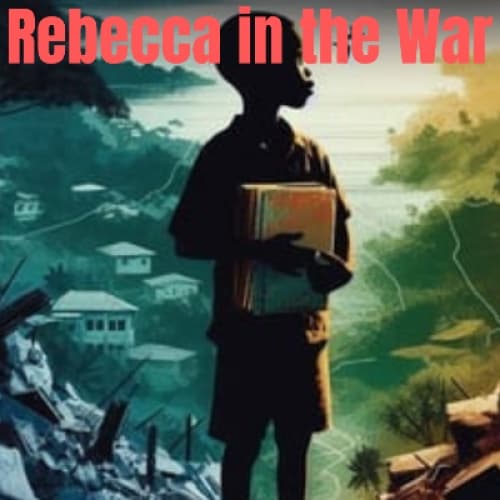
My real name is Rebecca, given to me by my biological parents. I was just three years old when I lost them during the devastating Liberian civil war in 1996. The conflict claimed over 200,000 lives and drew in both ECOWAS and the United Nations. But even after so much loss, peace didn't last long.
I wandered the streets alone, passing lifeless bodies, unable to find my parents or any surviving family. Eventually, a child welfare team found me and took me to an orphanage. I stayed there for months, dreaming of the life I had before the war - of my parents, of laughter, of safety.
Many children were adopted into loving homes, but I didn't think it would ever happen for me. When no families came, conditions at the orphanage worsened. One day, the team loaded us into a truck. Among us was a big girl who looked at me and said, "We're going to be okay," as she gently wrapped her arm around me.
After an hour, they took me from her arms and placed me at a family's house, along with a bag of rice, beans, and a bucket. One man from the team knew the family well. I cried for my mother - I wanted her near me. The man told me I would be okay, but I didn't feel it.
I arrived at the family's house and was placed in the care of a grandma but because she old she allows her daughter Tete to. Her room was large and beautiful, with its own bathroom. That first night, I slept on a mat on the floor. The next morning, I woke up crying for my mom. I even lay down on the road outside, sobbing until I was exhausted. When I returned to the yard, everyone stared at me.
Tete came over and asked, "Why do you keep crying? You're going to be alright."
"I want to go to my mom," I said through tears.
"Okay, we'll take you to your mom," she replied, then walked away.
Later, Grandma came outside to get water and saw me standing silently. One of her daughters told her I hadn't spoken to anyone all morning. Grandma called me, but I refused to go. One of her daughters said, "She's stubborn, Mama."
Grandma grabbed me and beat me all over my body. She carried me around the yard, calling out her children's names. "That stubborn spirit inside you - I will get it off you," she said.
Months passed, and Tete decided to take me in as her own child. She changed my name and date of birth - perhaps because no one knew exactly when I was born. She named me Dottie Jackson and gave me the birthdate December 25, 1990. Jackson was her mother's last name.
But every time they called me "Dottie," I would say, "That's not my name. My name is Rebecca."
I remember One morning, Tete beat me badly with a yellow wire because I had pooped in her room. The marks covered me from head to toe. I couldn't sit or lie down properly - the pain was unbearable.
I didn't have many friends. The only ones I had were the other children in the house and from the community. All of them had parents. I was the only adopted child in the house. I laughed and played with them, but deep inside, I felt lonely. I had no one to call "Mama" or "Papa." Richard was the only boy who played with me in the community. He made me feel less lonely.
In 1997, I started school in a small house. The building was old and owned by a local family who wanted to help children get an education after the war. I was placed in K-2, the only class they offered. I had one close friend in school - a girl who lived nearby. She was kind and made me feel less lonely
That year, the bloodshed in Liberia slowed, but it didn't stop. Violence kept flaring up. President of the country faced constant insurgencies, and rumors spread that he was trading weapons for diamonds with rebels in neighboring countries like Sierra Leone.
During one outbreak of violence, we all fled to the church and stayed there for two or three days. People were dying everywhere. When the shooting calmed down, Grandma said we could return home. But as soon as we got back, the bombings picked up again - this time, right near our house. The noise and shock affected my hearing. My ears hurt for weeks. They took me to the hospital, but the doctors couldn't find the cause. The war was still raging.
Later, Tet's uncle, Joe, who worked in the government, decided to take some of the family to Ivory Coast. Grandma, Tete, Annie and her daughter Susu, and Tete younger brother Zay, and I all climbed into a truck. They covered us with something heavy as we traveled by road. I was terrified when we reached the border. The rebels ordered us out of the truck and pointed guns at us. My heart raced. My body shook. I thought they were going to kill us. But they let us go.
We arrived in Abidjan, Ivory Coast, late at night and stayed at Joe family apartment. The area was lively, with Ivorians everywhere and a mall not far from the compound. I spent time with Susu, Tutu-girl, her stepsiblings, and other children. We ran around the neighborhood and even made friends with an Indian girl whose mother lived nearby. For the first time in a long while, I felt like a child again.
Eventually, we moved to Danané because the apartment was too small. The new house was big, girls had their own room, and one boy among us, JR, had his own space. JR loved spending time with his sisters. We played together, walked down the hill, and hung out with Ivorian children. Our neighbors were kind and welcoming. We attended a Liberian church nearby, and life began to feel more stable.
One Sunday evening, after church, it started raining heavily. We stopped to wait for the rain to pass, but JR said, "The rain won't stop just now, so let's run through it."
"I don't want to get sick ooh," I said.
"You won't get sick, baby girl," he replied.
We all looked at each other, then ran under the rain. By the time we got home, we were soaked. I caught a cold and started shaking. JR noticed and wrapped a towel around me, rubbing my arms to help me warm up. Soon, I developed a fever. My skin burned, and I felt weak. Tete and the other family members were worried I might die. One of our Ivorian neighbors gave me a bitter herbal medicine. I drank it and lay down on the porch while the other children played.
JR came over and said, "I'm the reason you're sick. I'm sorry."
His mother asked, "What did you do to her?"
"I put her under the rain when we were coming from church," he said.
"But why couldn't you wait for the rain to stop?" she asked.
"I was hungry," he replied.
"Next time, don't do that," she said gently.
Months later, Tete moved out to her own house. She took me, Susu, Annie, Zay, and Grandma stepchildren Emile, and his sister with her. Tete's sister from her father's side also joined us. The new house had two bedrooms and one bathroom. We all slept together on mats in one room.
The neighborhood was full of Ivorians, and the house was surrounded by a fence. Right near the fence was a busy mall that made noise every Tuesday and Thursday. I made a new friend - an Ivorian girl named Boll. She was kind and generous. Whenever she cooked, she made sure we tasted her food. She even let us into her house to watch TV.
Every weekend, a popular movie aired, and her house would be packed with people. At night, Boll sold salad on the road. It was the best salad I ever tasted in Ivory Coast. She taught me French and treated me like her play daughter. She went to school three times a day, which drove me crazy. I didn't want to learn that way, but she and her brother were very nice to us. Her brother became our study teacher, preparing us for school even before we officially enrolled.
Eventually, I started attending the church school and entered first grade. I made new friends there. Interestingly, the same people who attended church were also my classmates. Around that time, Joseph Robert married his girlfriend. The wedding was huge - full of joy, music, games, and drama. Right after the wedding, we had a church program with family and friends. It was one of the happiest times I had in Ivory Coast, surrounded by Liberian and Ivorian friends and family.