


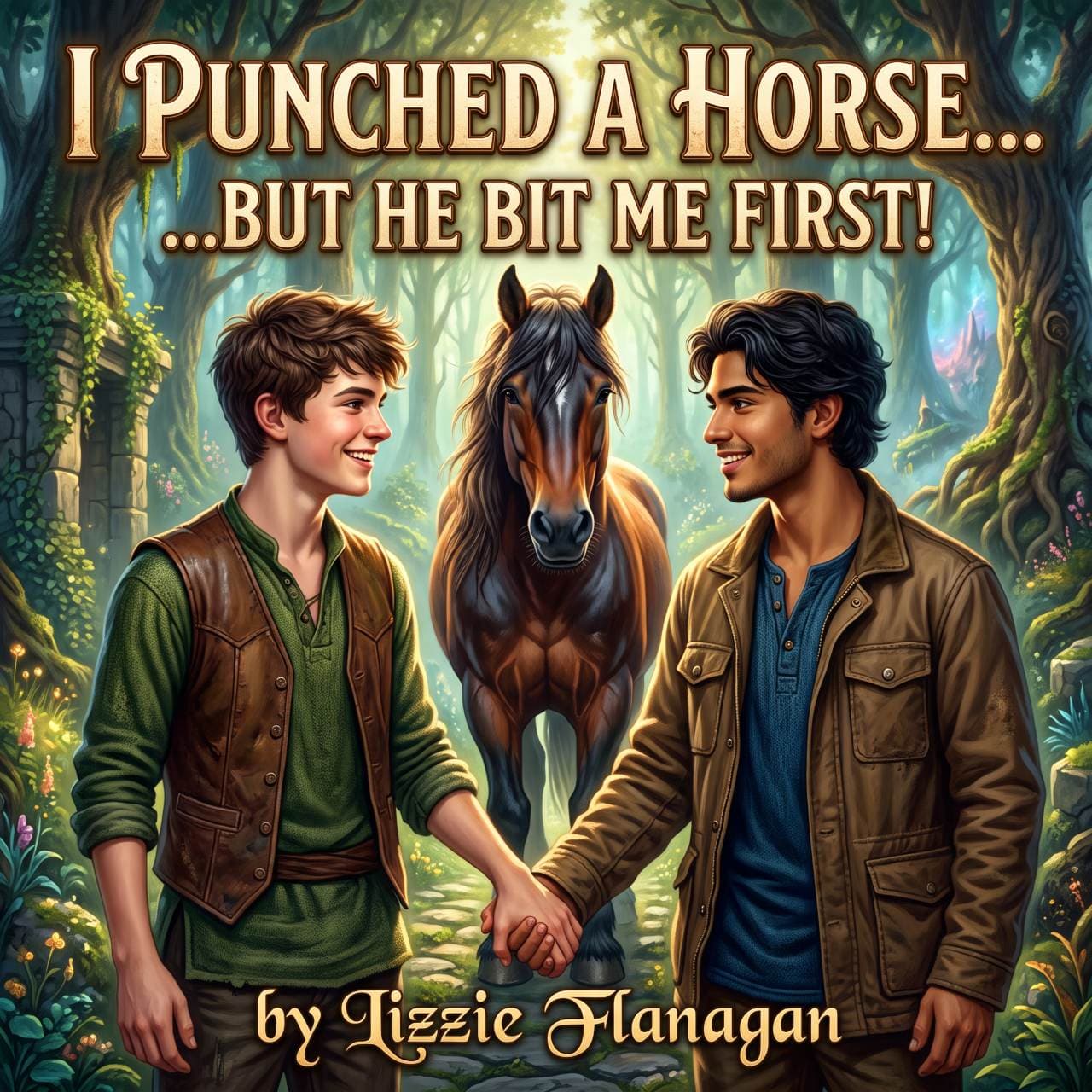

The first time I realized I might be catastrophically different from everyone else in my small town of Millbrook, Indiana, I was seventeen years old and standing in a pasture, covered in mud, having just punched a horse in the face.
Let me be clear: the horse bit me first.
His name was Thunderclap, which was a ridiculous name for a horse that looked like a depressed sofa with legs. He belonged to the Hendersons, who lived three farms down from my family's modest homestead, and he had developed what I can only describe as a personal vendetta against me specifically. Every time I walked past their property on my way to the bus stop, Thunderclap would amble over to the fence and stare at me with the kind of judgment usually reserved for Catholic grandmothers and talent show judges.
That morning in April, I had been particularly lost in thought. Specifically, I was thinking about Jesse Martinez's collarbones, which had been occupying an embarrassing amount of my mental real estate lately. Jesse had been my best friend since we were both in diapers, back when our mothers were in the same book club and our fathers bonded over complaining about corn prices. For seventeen years, Jesse had simply been Jesse—the kid who shared his Lunchables with me in kindergarten, who taught me how to ride a bike, who held my hair back when I got food poisoning from bad chicken at the county fair.
But sometime around February of junior year, Jesse's collarbones had staged a coup against my sanity, and now I couldn't look at him without my stomach performing an elaborate gymnastics routine that would have earned a perfect ten at the Olympics.
This was, I had recently realized, extremely gay.
Not just gay, but disastrously gay. Catastrophically gay. The kind of gay that, in Millbrook, Indiana—population 4,200, home of the World's Largest Ball of Twine (we were very proud), and approximately zero openly LGBTQ+ adults—felt like trying to explain quantum physics to a room full of golden retrievers.
I was so lost in contemplation of Jesse's collarbones and what they meant for my future as a functional human being that I didn't notice Thunderclap had escaped his enclosure until I felt his teeth clamp down on my left shoulder.
"Jesus CHRIST!" I yelled, which was probably not what Jesus would have wanted his name used for, but I was seventeen and being mauled by livestock.
Thunderclap had my jacket in his teeth and was attempting to drag me toward what I can only assume was my certain doom. In my defense, I didn't want to punch a horse. I had nothing against horses generally. They seemed fine, as far as large animals that could kill you went. But survival instincts kicked in, and before my brain could catch up to my body, my right fist had connected with Thunderclap's nose.
The horse made a sound like a disappointed tuba and released me. Then he bit me again, this time on the arm.
This went on for what felt like forty-five minutes but was probably closer to ninety seconds—me punching, Thunderclap biting, both of us making increasingly unhinged noises—until Mrs. Henderson came running out of her house in her bathrobe, screaming about animal cruelty and calling me a "delinquent" and threatening to call my mother.
I stood there, bleeding slightly from three different locations, covered in mud and shame, and realized two things simultaneously:
First, I was definitely going to need a tetanus shot.
Second, I was going to have to figure out how to be myself in a world that seemed designed for people who never had to punch horses or contemplate their best friend's collarbones.
My name is Charlie Brennan, and this is the story of how I learned to stop punching horses—metaphorically speaking—and start fighting the battles that actually mattered.
By the time I limped home, my mother had already received three phone calls about the incident. This was Millbrook; news traveled faster than the internet, which was convenient since half the town still thought the internet was a passing fad.
"Charles Michael Brennan," my mother said as I walked through the kitchen door, using my full name like a weapon. She was standing at the stove, still in her scrubs from the night shift at Millbrook General, looking simultaneously exhausted and ready to ground me until retirement age. "Did you punch the Hendersons' horse?"
"He bit me first," I said, which I was going to be saying a lot for the next several weeks.
"Mrs. Henderson says you attacked Thunderclap unprovoked."
"Thunderclap is a menace to society and also my arm." I held up my jacket, which now featured a hole the size of a grapefruit. "Look at this! This was my good jacket!"
My mother sighed the sigh of a woman who had raised three children largely by herself while her husband worked double shifts at the auto plant in Fort Wayne. My father was a good man—present, supportive, prone to dad jokes that made me want to die—but he was gone sixteen hours a day, which meant my mother had borne the brunt of parenting decisions, emotional labor, and emergency room visits.
"Sit down," she said, pointing to the kitchen table. "Let me see your arm."
I sat. She examined the bite marks, which were already bruising impressively. They would look spectacular by tomorrow, a purple-green constellation of equine aggression mapped across my bicep.
"You're going to need a tetanus shot," she confirmed, which I had already known but appreciated the medical validation.
"Can you take me?"
"Your father can take you when he gets home. I need to sleep." She pressed a bag of frozen peas against my arm and sat down across from me, studying my face with the kind of intensity that made me nervous. My mother had always been able to see through me, which was inconvenient when you were hiding something like catastrophic homosexuality. "Charlie, what's going on with you?"
"Nothing," I said automatically, which was the wrong answer because it made her eyebrows go up.
"You're punching horses. You're distracted at dinner. You jump every time your phone buzzes." She paused. "Is this about a girl?"
The question hung in the air like a cartoon anvil, waiting to drop on my head.
In that moment, I considered telling her. I really did. My mother was a good person—a nurse who treated everyone with the same professional compassion, a woman who had once yelled at a man in Walmart for using a slur against the cashier. She had raised us to be kind, to be fair, to judge people by their actions rather than their differences.
But she had also raised us in a church where the pastor still gave sermons about "traditional families." She had also raised us in a town where "gay" was still the worst insult you could hurl at someone in the locker room. She had also raised us in a world where every movie, every TV show, every billboard on the highway showed the same story: boy meets girl, boy falls in love with girl, boy marries girl and has 2.5 children and a golden retriever.
And I didn't know how to tell her that I wasn't going to be the boy in that story. That I was going to be the boy who fell in love with another boy, and that the boy I was falling in love with was Jesse Martinez, who had slept over at our house at least two hundred times and whom she loved like a second son.
So I said: "Yeah. It's about a girl."
The lie tasted like copper in my mouth.
My mother's face softened immediately, because of course it did. The "girl" explanation made sense. It fit the narrative. It was the story she was expecting, the one she knew how to respond to.
"Oh, Charlie." She reached across the table and took my hand. "Is it someone I know?"
"Just... someone at school. It's not serious."
"Well, when you're ready to talk about it seriously, I'm here. And your father too." She squeezed my hand. "But please stop punching horses. We can't afford a lawsuit."
I promised to stop punching horses, which was easy enough since I had never intended to start.
After she went to bed, I sat at the kitchen table for a long time, staring at the frozen peas melting against my arm, and thought about how coming out was supposed to be this big, brave moment. In the movies, there was always crying and hugging and dramatic music. In the movies, parents either disowned you immediately or embraced you with teary-eyed acceptance.
But real life, I was learning, was messier. Real life was frozen peas and half-truths and the crushing weight of knowing that even the people who loved you most were carrying around assumptions so heavy they could crush you without even meaning to.
My phone buzzed. It was Jesse.
Jesse: dude i heard you punched thunderclap???
Jesse: that's AMAZING
Jesse: that horse is a dick
I stared at the screen, my heart doing that stupid gymnastics routine again. Jesse thought I was amazing. Jesse, with his collarbones and his easy laugh and his ability to make me feel like the most interesting person in any room.
Me: he bit me first
Jesse: classic victim blaming
Jesse: horses are toxic
Jesse: when are we hanging out i miss your face
I miss your face. Four words. Innocent words. The kind of thing friends said to each other every day.
But my traitorous heart didn't hear "friend." My traitorous heart heard "I miss your face" and translated it to "I miss the way your eyes crinkle when you laugh" and "I think about you when you're not here" and "maybe we could be something more."
Which was ridiculous. Jesse was straight. Jesse had dated girls—Sarah Howerton sophomore year, briefly, and then that girl from the volleyball team whose name I couldn't remember because I had blocked out most of Jesse's dating history as a self-preservation strategy.
But still. Still, I typed back:
Me: whenever you want
Me: i always want to see you
I stared at that second text for a long time before sending it. Was it too much? Was it too obvious? Would Jesse read into it the way I would read into it if he sent it to me?
I sent it anyway. Then I put my phone face-down on the table and went to take a shower, where I could cry about my life without anyone asking why.
The next morning at school, the horse-punching incident had achieved legendary status.
"Yo, Brennan!" Brad Williams called out as I walked down the hallway. "You get in a fistfight with a horse? That's hardcore!"
"I didn't—he bit me first," I said, which was becoming my official slogan.
"That's what they all say," said Jenna Goldstein, who was on the student newspaper and had already tried to interview me twice. "Did you really punch it in the face? Can I get a quote for the Millbrook Mirror?"
"Leave him alone," said a voice behind me, and then Jesse was there, his hand on my shoulder, his collarbones at eye level because I was a disaster. "The horse had it coming. Everyone knows Thunderclap is an asshole."
"Thank you," I said, meaning it more than I could express.
Jenna wandered off, disappointed, and Jesse steered me toward our lockers. His hand stayed on my shoulder, warm and heavy and perfect, and I tried very hard not to read into it.
"Seriously, though," Jesse said, "are you okay? Mrs. Henderson is telling everyone you tried to kill her horse."
"I'm fine. Just bruised." I rolled up my sleeve to show him the bite marks, which had developed into a spectacular purple-green-yellow rainbow of equine aggression.
Jesse winced. "Damn. That looks like it hurts."
"It's not that bad."
"You're such a badass." Jesse grinned at me, and I felt my knees go weak, which was embarrassing and also probably medically concerning. "Punching a horse. Next you'll be wrestling alligators."
"I don't plan to make a habit of assaulting animals."
"Shame. I'd pay to see that." Jesse leaned against the locker next to mine, too close, always too close. "Hey, my mom's making enchiladas tonight. You should come over. We could study for the English test, or not study, whatever."
"I have to get a tetanus shot after school," I said, then immediately regretted it because what if that made me sound like a child who couldn't handle a little horse bite?
But Jesse just nodded. "Cool. After that, then. I'll tell her to set an extra place."
"Okay," I said, trying to sound casual and not like my heart was trying to escape my chest. "Yeah. Okay."
The bell rang. Jesse squeezed my shoulder one more time—just friendly, just friends, just two dudes being dudes—and headed to class.
I watched him go, watched the way his shoulders moved under his t-shirt, and thought about how unfair it was that the world had made me feel like wanting this—wanting him—was something wrong, something broken, something that needed to be fixed or hidden or prayed away.
Thunderclap the horse had bitten me because he was scared, or territorial, or just having a bad day. I got that. I understood lashing out at things you didn't understand.
What I didn't understand was why the world seemed so determined to bite me first, and then blame me for punching back.