


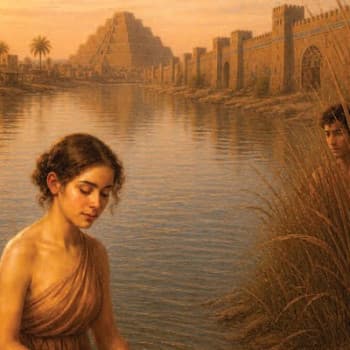

Once the garden has been tended to, Akki approaches his father to share his intention on joining the king’s army.
“I am of age where I must serve my king now, Father,” Akki pronounces.
“Nonsense. You are too young and it would be rather burdensome for me to bear all the garden duties by myself,” sternly replies the father.
“I’m 14 now and can earn wages as a bowman to help our family,” retorts the son.
“I know you are a skilled archer son, but I cannot let you partake in such reckless pursuits.”
“Well, I’m now a man, Father, and my duty calls, no matter what may come,” Akki defiantly asserts.
Feeling rather pensive on the matter, Duzi pays a visit to Shuk for his advice.
The priest recounts a foretelling dream he recently had about Akki being a virtuous soldier.
“It is a good omen,” assures the priest to Duzi, continuing, “an auspicious sign.”
“He is too young and I am gravely concerned for his safety,” maintains the father.
“His fate is not in peril,” insists the priest.
A week later, Duzi and Akki, accompanied by the priest, are received at the court of Nebuchadnezzar II for an audience.
With all three standing before the king the priest commences, “My Lord, your subject, Duzi’s son Akki, is eager to become a soldier and serve as a temple archer in service of your kingdom.”
“He seems quite young to serve as a sirku in my infantry,” professes the king. “Akki is a skilled bowman. And it has recently been revealed to me in a dream that your Lord will reap propitious outcomes in future campaigns if he joins your troops,” further explains the court’s priest. “Very well. He can demonstrate his bowmanship and if he proves worthy, I will assign him as a sirku apprentice.” Moments later Akki is put to the test in the king’s courtyard for which he performs rather adeptly.
Satisfied with his proficiency, the king arranges for the young man’s recruitment.