


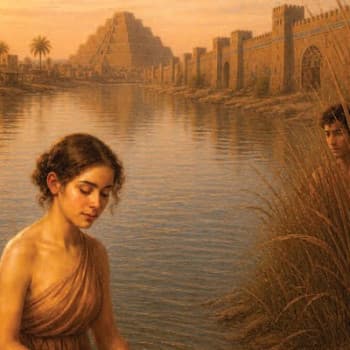

Ahma’s heart is pounding through her chest.
She is being chased at great speed by a monstrous creature with four elongated horns atop its hideous head with striking white eyes, a long sharp tongue, and a dog-like body with hardened, furless grey skin. Sharp claws from the ends of its four legs helps to precipitate its rapid pace across the path. Sprinting along the banks of the Euphrates, Ahma senses the beast rapidly gaining ground on her. She turns around to notice the grotesque beast that is now just a few meters behind her before tripping and crashing onto the ground. She can no longer move. Ahma is paralyzed both in fear and in movement.
As the beast is just about to jump on her, she awakens in her bed, releasing a blaring shriek that alerts her father who is plowing his field outside their mudbrick dwelling. He drops everything and rushes towards her, immediately noticing her red-flushed face and heavy breathing. “I’m here, I’m here love,” utters the concerned father before tending his hand over her forehead. “It’s just a dream,” he says to comfort her.
“You have a burning fever” continuing, “let me fetch you some water.”
“Get some rest and I will pay the priest a visit this afternoon for his thoughts on this affliction. It’s been long enough!”
Early that afternoon Duzi, a peasant farmer and skilled craftsman, heads towards the priest’s home with concernment ill spared.
Favorably, Duzi had recently helped Shuk renovate the roof of his private residence, and thus feels less reluctant in seeking assistance for his troubled teen.
Upon Duzi’s arrival, Shuk readily senses his angst. “What is it my friend?” asks the priest. “Ahma,” commences Duzi, continuing after a slight pause, “I am now convinced she is cursed to suffer an impending disease.”
“She’s had the same nightmare for two weeks now, becoming increasingly benumbed in body and spirit.”
“It’s Asag,” asserts Shuk.
“The demon?” inquires Duzi.
“Yes,” confirms the king’s priest.
“Is she ill-fated?” inquires the increasingly concerned father. “No. Here is what we are going to do,” reassures Shuk.
It is not the first time that the priest has had to intervene in such matters. Knowing Duzi’s modest dwelling, Shuk tells him to return the next day, and prepares four bowls on which he inscribes spells in spiral fashion on the inside of each, starting from the base all the way to the rim. At the center of each bowl, he draws an image in the likeness of Asag. The spell’s purpose, as tradition holds, is to trap and bind the demon.
When Duzi arrives the next morning, the priest explains that he must take the four hardened clay bowls and place them face-down slightly beneath the soil at each corner of his house to ward off the demon and prevent him from entering the premises and Ahma’s sanctum.
“I am forever grateful, and in your debt, good priest,” lauds the farmer.
Two weeks pass and Ahma seems fully recovered.
As a token of his gratitude, Duzi offers his best goat to Shuk.
The priest recognizes it as a sign, brings it to the Esagila—the temple dedicated to Marduk, the protector god of Babylon—and sacrifices the beast before examining its liver.
What he suspected is now confirmed.